September 25, 200818 yr Hi everybody , Is there anybody out there that has either rebuilt or has information on Gas Gas 325 Aire . I am part way through restoring this bike , my aim is to make it suitable for Long Distance Trials . Any help such as pictures , Workshop Manuals , Part suppliers and repair specialists would be great ,Cheers Nick
September 26, 200818 yr Hi everybody , Is there anybody out there that has either rebuilt or has information on Gas Gas 325 Aire . I am part way through restoring this bike , my aim is to make it suitable for Long Distance Trials . Any help such as pictures , Workshop Manuals , Part suppliers and repair specialists would be great ,Cheers Nick Try http://www.gasgasmuseum.com/ for a start. The German site at http://www.gasgas.de/ may have a parts manual under "Esatzteile" but some are difficult to read. Jon
September 26, 200818 yr Hi Nick, I have a 250 version sitting in the garage that we rebuilt last year as a school project. It is a 1989 model, the aire 325 will be from the same era. I'll get Tim to upload a photo to the site for you. The motor is an early Gas Gas based on a Villa unit, from Italy. Big clunky gears, thick sandcast housings, it's all very sturdy. The piston is the same as the much later 321, but no longer available from Mahle, S3 produce them now though fairly dear - available via your GG importer - if you live near Ilkley (Moor?) then best first point of call would be White Bros in Darlington. Clutch plates don't match the 321 motor but you can make them fit with a little filing out as the tabs are slightly different. The cylinder bore is an early plated design, may be nickel/silicon, it has lots of porous looking pin holes but this is a standard finish. Mahle piston rings will fit, the old Bultaco 325 rings can be adapted to fit, 1st or 2nd oversize but only the thinner of the pair of rings. Rear linkage bearings from a 95 model can be used, same for brake pads. Forks are 35mm Marzocchi's, seals and bushes are still available. The bike rides well, is pretty heavy, gear ratios are fine, footrests are way too high and forward, try to relocate these as low and as far back as possible with wider, Hebo type footrests. There are no workshop manuals, ask in the forum if you come up with a problem, it's an easy motor to work on. Motoplat ign works ok but has gone out of business. Crankshaft oil seals are the same as the 95 bike. Great thing with this bike is that it has a seat that is close to being comfortable, also the airbox is quite waterproof. Carb is a scabby little 25mm DellOrto, tightly squeezed in, would be better with a 26 if there is room. Bye, PeterB.
September 26, 200818 yr The cylinder bore is an early plated design, may be nickel/silicon, it has lots of porous looking pin holes but this is a standard finish. Peter, That sounds like Kawasaki's electrofusion process they used during those years. It's a process that leaves a porous, hard coating of molybdenum and steel permanently secured to an aluminum bore by using high voltage during manufacture. As I understand, the process involved thin Moly and steel wires located inside the bore lengthwise and then vaporized with high voltage. Sounds kinda Dr. Frankenstein-like in it's process, but the coating was quite durable when properly cared for. Jon
September 27, 200818 yr Thanks for that Jon, I do appreciate your pearls of wisdom in defining technical oddities. When I first saw the old 250 cylinder I thought the plating had gone off, with the surface finish looking as it did. A new cylinder had an identical bore. I had heard of electrofusion but did not know how this was applied, wonder how the plating could be made to be uniform, or was it later bored/honed? Bye, PeterB.
September 27, 200818 yr Thanks for that Jon, I do appreciate your pearls of wisdom in defining technical oddities. When I first saw the old 250 cylinder I thought the plating had gone off, with the surface finish looking as it did. A new cylinder had an identical bore. I had heard of electrofusion but did not know how this was applied, wonder how the plating could be made to be uniform, or was it later bored/honed?Bye, PeterB. Peter, From what I remember, the coating is made up of a series of vaporized wires, I think it was 8-10 each of the Moly and steel (not sure, however) and the cylinder was thermo-normalized and then rigid diamond honed. I worked on a lot of bore plating types, such as the early Yamaha chrome, Suzuki Boron-Composite, Kawasaki Electrofusion and the Honda Nikasil. The Electrofusion plating was a lot thicker than the Nikasil and therefore easier to work with when it came to modifying ports, but it does look like someone acid-etched the bore when you first see it. Jon
September 27, 200818 yr Author Hi to everybody , Thanks for all the helpfull information , It's comforting to know there is so much knowledge out there . As things progress I am sure I will be asking for your help again . Cheers Nick
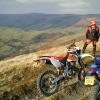
October 27, 200916 yr Author Hi to everybody that replied to my last question and helped me move forward with the rebuild . The bike is now up and running , just some snagging to fix before i have it M.O.Td . and road registered . so once again thanks especially to Al the spanner at White Bros ,Peter Ruscoe and everybody at Shirtys , Nickrhinos


Join the conversation
You can post now and register later. If you have an account, sign in now to post with your account.