

konrad
Members
-
Joined
-
Last visited
Everything posted by konrad
-
I'm not sure where to go with this question. There is already a topic here on the Easy Start: https://www.trialscentral.com/forums/topic/60767-ossa-easy-start-unit/ I would like to upload the complete Easy-Start Instruction Manual, entitled "INTRODUCTION OF OSSA START SYSTEM ASSIST" but it's a 14.5 MB .pdf file, and I that exceeds my allotted storage space.
-
If I'm not mistaken, that engine is based on Yamaha's TT-R125. The pilot jet on the TT-R is notoriously small and easily plugged. Just spraying carb clean at the carb won't fix it. Remove the pilot jet and make sure you can see light through the orifice. You can gently pass a fine wire thought the jet's orifice to clean it.
-
When you do this, may I suggest adopting a standardize testing methodology. I would suggest testing a fully-warmed bike, and letting it sit 5 - 6 minutes between tests.
-
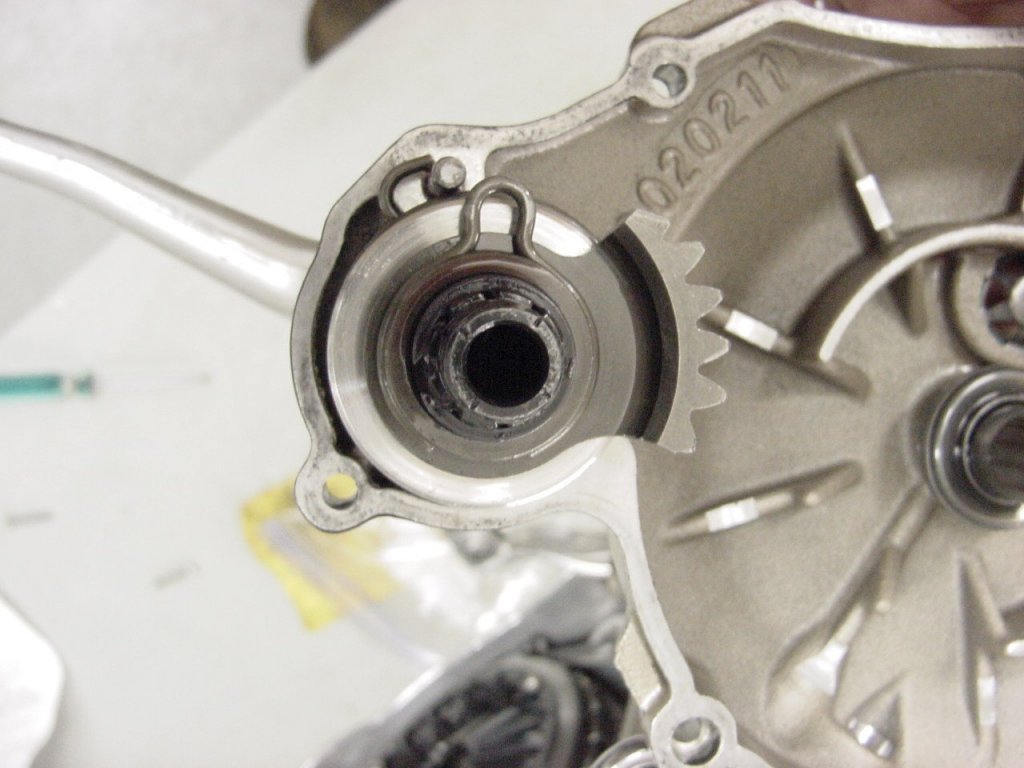
I suspect it's just been misassembled. You must wind the kickstart return spring up slightly from its relaxed position prior to putting the clutch cover back on. Make note of the thrust washer at the end of the kickstart shaft (not shown in the photo below). It's easy for this to fall off during reassembly. I grease this washer to help keep it in place, and lean the bike to the right when installing the clutch cover. Take reference photos during disassembly. The "loop" in the kickstart spring fits into a mating area in the engine casting.
-
That's the filter capacitor. Because you removed the Easy-start, I would not remove the filter capacitor. It's possible the life of the ECU and fan could be shortened without it.
-
I used IRF18650 cells rated at 1100 mAh. It's certainly possible you could get by with less, I did not do an analysis. One other thing... Mark has had very good luck with 1-kick starting, whereas my bikes require 2 to 2.5 kicks. I'm wondering if there is any correlation between kick-starting and fuel pump voltage/pressure? The ECU assumes a particular fuel pressure when it decides how much fuel to inject. The fuel pressure does not stabilize until the engine has run for, I'm guessing, a second (it's some short non-zero time, anyway). A higher battery voltage would cause more fuel to be injected. I don't know if there is anything to this, but I'm throwing it out as a possibility. Seemingly small changes have had a big impact my OSSAs.
-
That's a bit like asking, "What's the best religion" isn't it? I'll try to be objective. I can't disagree with anything written above, but will add... I've always loved the challenge of tuning 2T engines, but can't get away from the fact they are very dirty (environmentally). A 4T is going to get better fuel economy and emit far fewer unburned hydrocarbons than a 2T. I'll also state up-front that the vast majority of my motorcycles have been built in the land of the rising sun and I'm relatively new to trials (6 years). The Japanese have an attention to detail second to none. So, my acquaintance with the quality control (or lack thereof) of modern trials bikes came as quite a rude surprise. When I think 4T trials, I only think HRC Montesa. I have ridden two of them, one very old and one very new for about an hour each. Neither instantly made me a better rider. (I also rode a 4T Sherco that was very difficult to start but probably had setup/maintenance issues.) Some 4T pros: Really great service manual -- download one and see for yourself. Auto-decompressor makes them easy to kick. Can buy one from a Honda dealer. Some 4T cons: Higher initial cost. Heavy, but maybe not really objectionable until you have to drag one out of a ravine. I've heard owners complain about expensive parts. In the end, I'll stick with 2Ts until the Japanese produce a usable electric (are you listening Yamaha?). P.S. I really wanted to love the 4RT.
-
I'm not sure about the Explorer, but on the trials bikes the connector is near the cylinder head. The connector should have a "blanking plug" installed to keep dirt out. You are correct about the wire colors and polarities. If you have not seen it already, there's some relevant information here: https://www.trialscentral.com/forums/topic/69622-efi-ossa-notebook-formerly-tr280i-wiring-diagram-annotated-in-english/ Just BTW, the fuel pump does not run initially when using the Easy-Start system. Noticed Mark used 3 lithium-ion cells. These have a nominal cell voltage of 3.6 to 3.7 (a 3-cell series pack gives 10.8 to 11.1 V). I used a different battery chemistry (lithium-iron-phosphate) which has a nominal cell voltage of 3 to 3.4 (a 4-cell series pack gives 12 to 13.6 V). The advantage of LiFePO4 is that it may be charged directly from the OSSA's electrical system.
-
Yes, and still does. My understanding is that Curtis Leaverton, a big player in aftermarket parts here in the US http://www.pivotworks.com/CompanyHistory.aspx was the original importer. Curt is still into classic OSSAs https://www.vintco.biz/ossa-world
-
Version 1.0 is now available in the first post. I've fixed a lot of typos, some flat-out wrong information (mostly about gearbox ratios), and added 6 pages of content. The stuff I added on disc springs, XiU-rdi's clutch components, flywheel weights, and the Clake OLC may be of general interest. As an aside, this document has been downloaded 50 times. For comparison, my document about fabricating a diagnostic interface has been downloaded 155 times. I would have expected those numbers to be reversed. Happy New Year!
-
Curiosity, mostly. But also to get an idea how many potential donor bikes might exist -- I'd like to keep mine running until they're considered "vintage." ? I have also read the 1250 number, but think it's optimistic. Inside the gearbox on my 2011 280 there's some CNC engraving that says "T.A.S. 212 10/49". I'm wondering if that means it was the 10th engine in a production run of 49 good castings? I assumed the runs would be small, but that quantity does not seem economical. My 2014 250 says "13/25".
-
If this topic has been discussed elsewhere, I could not find it. I'm curious how many bikes (and of what type) were actually produced. If the numbers are unknown, maybe we can estimate them from VINs? I think my 2011 280 was a very early arrival in the US. Its VIN ends in 165. Same with my 2014 250, its VIN ends in 35.
-
Call me overly-cautious. Where?
-
Several members have ask me for help with Mapping/Upgrading issues. I'd be a lot more willing to experiment if I had an "expendable" ECU laying around. It does not necessarily have to be fully functional. I realize this is a long shot, with the small number of bikes built, but I'll put whatever I learn into the public domain.
-
Most current and complete information found here: https://www.ossa-efi.com/home/pc-software/diy-diagnostic-interface
-
Canada280i, I appreciate your comments. Regarding your experience with the Factory 300, how/when do you use each map? I'm guessing one is for wet conditions and the other dry. I'm wondering if that map made no difference in my 280 because it was just too rich everywhere (294cc verse 272cc) and that swamped any differences between the maps? As an aside, I've fixed many typos (and some outright errors) in v0.8 of the document. I'll be posting an update, but want to add a bit of content first. I'll also be starting a separate topic on fabricating an ECU diagnostic cable/interface.
-
Very insightful observation! That had not occurred to me. I have the head off one of the motors now, and it's easy to feel what's going on when you "kick it over" by hand.
-
So what does everyone think about the kick start lever hitting the footpeg? Most annoying. There's no way I can start the 280 with leg-strength only. I have to have give it a full body-weight straight-leg leap. When the 250 is warm, and I'm feeling lucky, I can occasional start it with just leg-strength. But it does not do my knee any good.
-
Tsiklonaut, as I recall you mentioned having a very high-compression head. One would think there is nothing simpler than a 2T head, right? But the devil is in the details. Small changes in squish clearance and/or blend radius (from bowl to squish band) can have a large impact on squish velocity, which in turn can have a large impact on rate of combustion and therefore combustion pressure rise versus crank angle. I always try to keep in mind the words of a famous racer and tuner, Kel Carruthers: "Give the bloody engine what it wants, mate."
-
I've replaced the annotated schematic and ECU pinout in the first post with a document containing that information and much more. It's my first draft (I'm calling it version 0.8) of things I've learned about EFI OSSAs. It's information I've pieced together from notes to myself and emails to friends. But it's more than just what I've learned by reverse-engineering the system. In may places (perhaps too many, perhaps not enough?) I've tried to add justification and background to my thought process. I'm releasing it into the public domain without restriction. If you read it, I'd appreciate feedback – good, bad or indifferent. If you feel something needs additional explanation, please say so. If you think there are errors or omissions, I'm happy to discuss it (either publicly or privately). I want to make the document as useful as possible. I figure all of us who own these bikes need to support one another.
-
Canada280i, does ambient temperature have an effect on your bike? Mine seems more likely to start on 1 kick when it's cooler outside, 50 F (10 C).
-
My 250 almost always requires 2 kicks. If I stop and immediately restart, 1 kick will usually do. But if it's stopped long enough to walk a section, it will probably require 2 kicks to restart. One the other hand, if the bike has been sitting for months it may start on a single kick. My 280 is somewhat more recalcitrant. It probably takes an average of 2.5 kicks. I have some theories as to why this might be so, but I'm wondering if others have managed to make theirs a 1-kick starter. This really doesn't matter during practice or if ridden as a trail bike, but during a competition it saps my limited energy. Both bikes have Easy-Start kits. I'm a bit of a lightweight at 142 pounds (64.5 kg).
-
I am so grateful for the help I received with my gearbox I want to give something back to this forum. I'm a retired electrical engineer and a hobbyist machinist. I have done a fair amount of work reverse-engineering the TR280i's electrical system. Cheers. I have replaced the .PDF file with an entire website: https://www.ossa-efi.com/home It corrects some errors and omissions as well as providing greatly increased technical content.
-
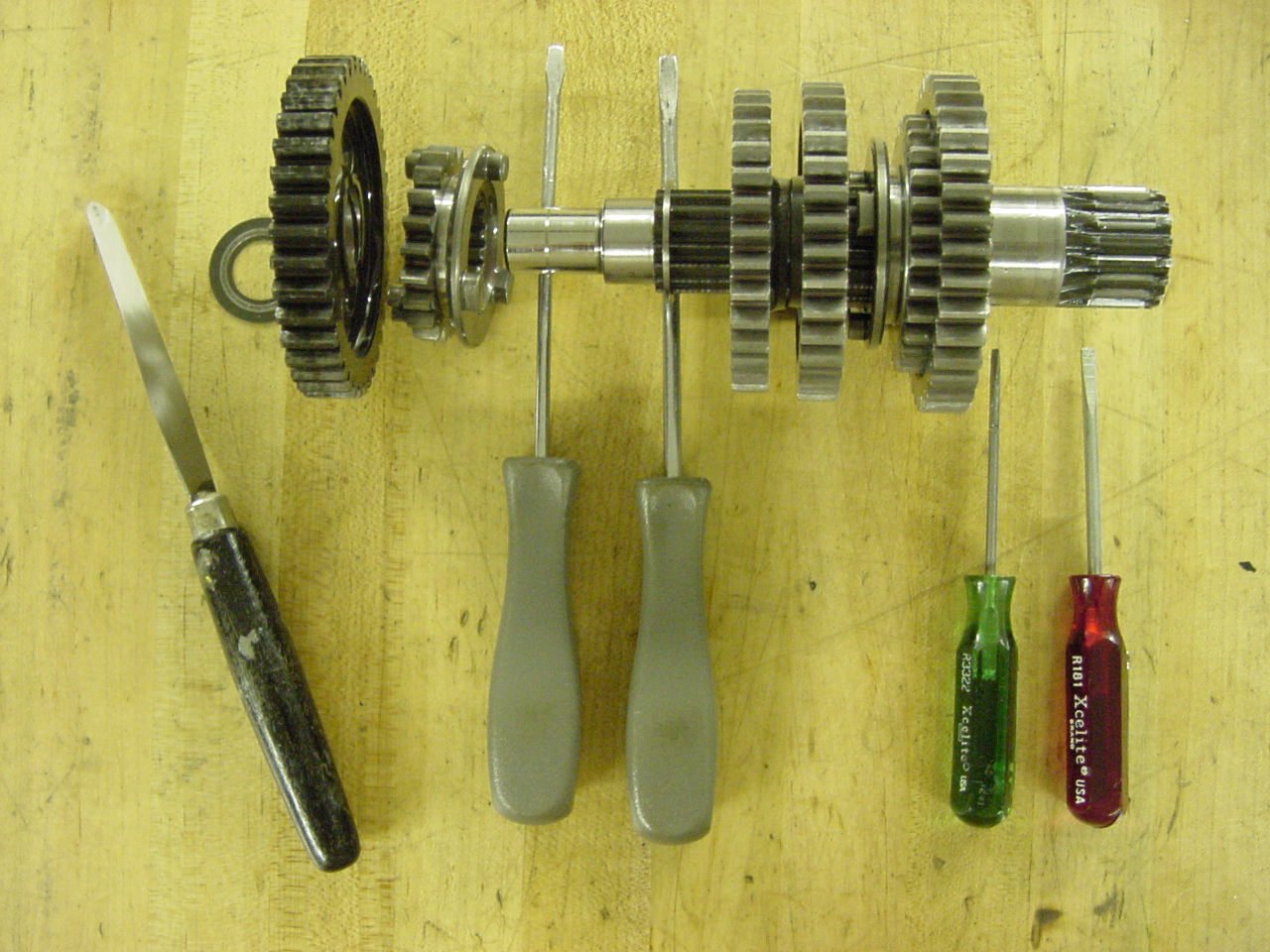
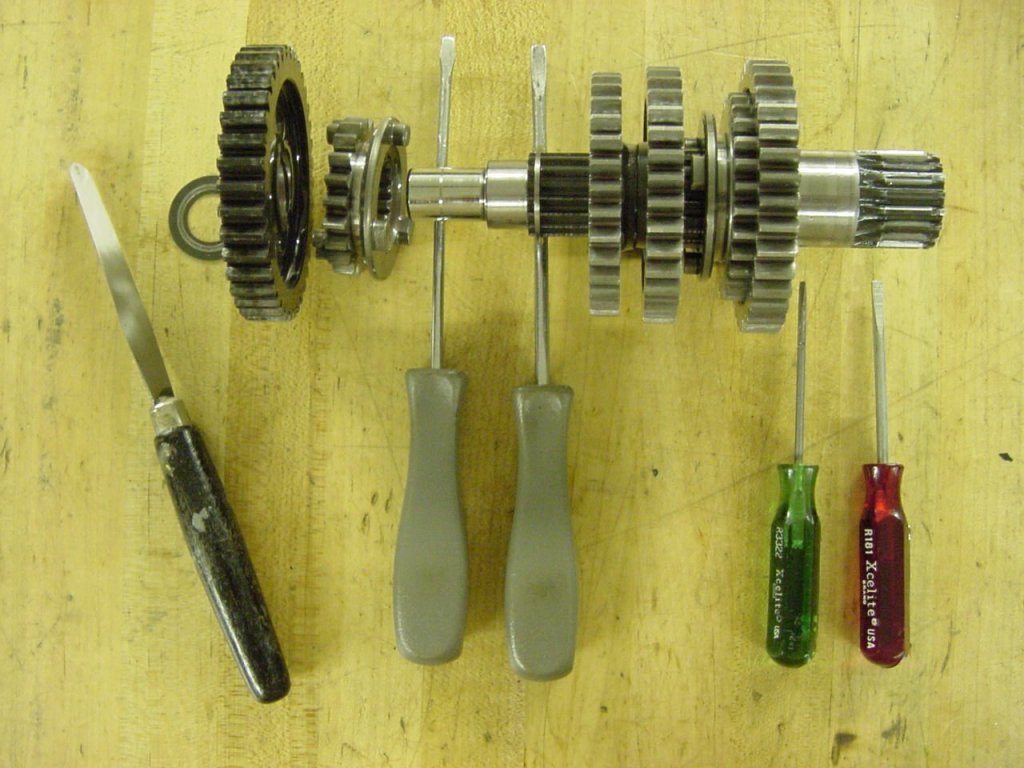
Peter, that was hugely helpful! Thanks a million! I never would have "guessed" that solution. Here's a pic for the next poor ******* who has to tackle this problem. The grey screwdrivers eventually worked. The red and green were too small. It helps to have the gearbox held rigidly (I lightly clamped it in a vise) when first moving the circlip. I had to progressively move the circlip along the shaft as more and more wiggle room became available. Eventually, everything just fell apart. I tried the pallet knife shown between the circlip and the adjacent gear, but it was not helpful. I removed the circlip completely as I did not want it stretched while I wait for bearings to arrive.
-
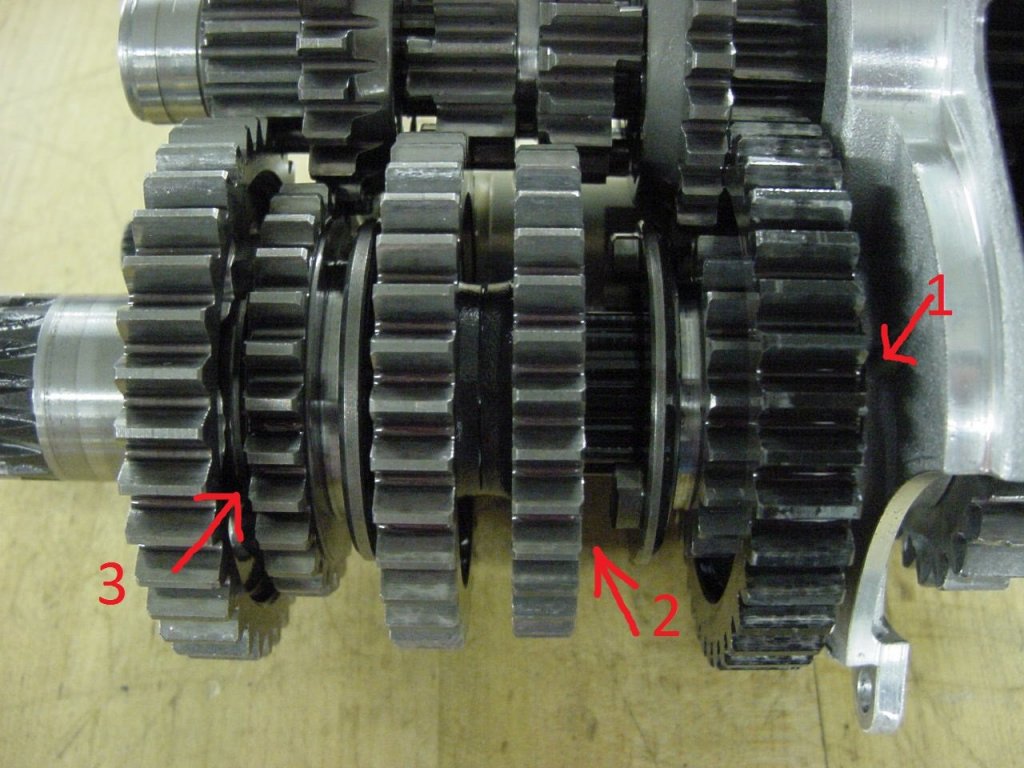
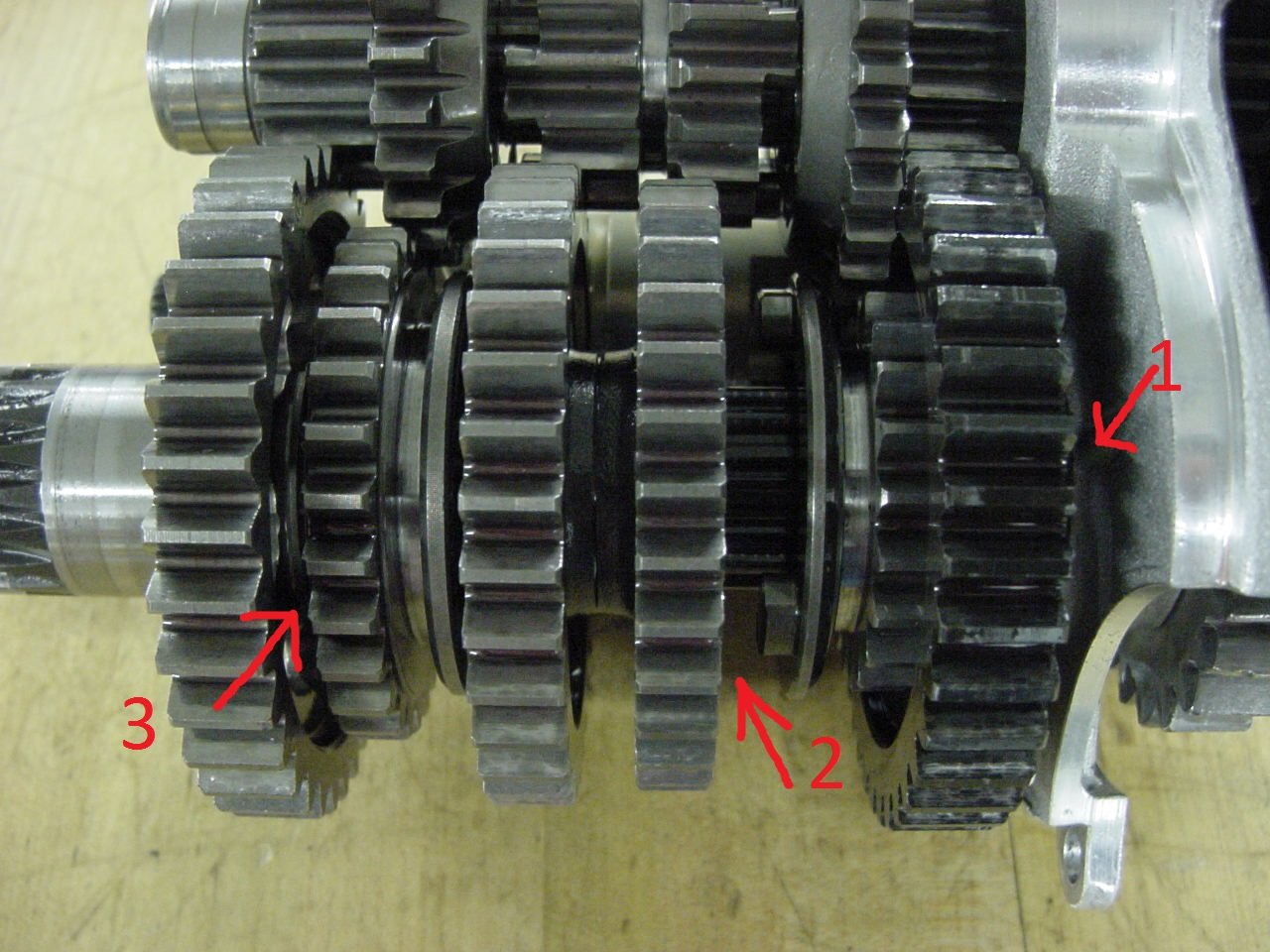
I now see 3 circlip locations, but none look like they would allow any gears to then be removed. Much more information here: https://www.ossa-efi.com/home/engine/gearbox