

dan williams
Site Supporter
-
Joined
-
Last visited
Everything posted by dan williams
-
No I’m saying the fan “controller” is in the radiator but you need the regulator to run the fan. Semantics.
-
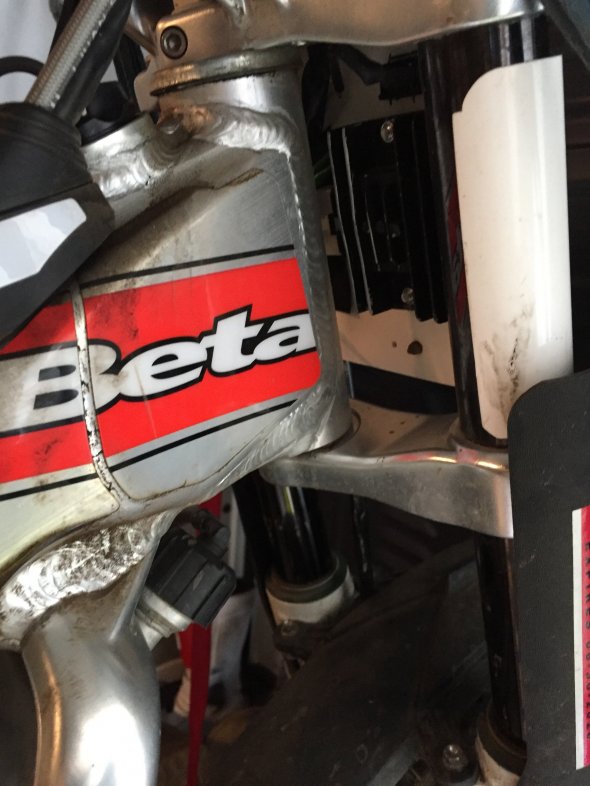
The rectifier/regulator that takes the ac from the lighting coils and makes 12V dc is in the headlight but the switch that controls the fan is the thermal switch in the radiator. The fan runs on the 12V dc as does any LED lights and possibly the microcontroller in the CDI. Any incandescent bulbs can run directly off the ac from the lighting coil.
-
It sounds normal on video but it's tough to tell anything not blatantly broken. The hill is probably not the most critical way to test. More its response to quick burst of throttle to get up a step.
-
Ok so I got my McMaster McWashers. Gonna try this out.
-
I have several friends that were hurt on trials bicycles. Those damn things are dangerous! I had a 2000 Rev3. I actually liked the upside down forks but they got a bad rap for flexing and making the steering imprecise. There was an aluminum fork brace you could get to make the front end stiffer. They say you should never buy the first year of a major change to a model but I really liked that 2000. Of course compared to the 2018 it's like steering the Queen Mary but for a starter bike it will be fine.
-
Unless you're an expert burning your clutch to do 8' splatters the clutch will last many years. Worst case you may have to dress the steel plates with fine emery cloth to deglaze them. Trials bikes are very unlike MX bikes so you are unlikely to ever replace a clutch pack for wear. The Sureflex fibers have been mentioned as being no better than stock. The Barnett plates are things of beauty but are only available in 3.0mm thickness where the stock Beta Adige plates are either all 2.7mm, mixed 2.7 & 3.0mm or in the case of the 4 stroke all 3.0mm. The newer plates from Beta seem to be much better as far as the glue goes. I really didn't have to do more on my 2018 than dress the tabs. As is the case with many manufacturers Beta's probably used clutch plates from the same production run for a decade and have only got new plates a few years ago. Trials riders tend to be very picky about controls so we spend hours tweaking them to be just right. Give it a few months on the trials bike trying to go slow and you'll find you notice stuff that never bothered you on any other bike.
-
Very familiar with the '08 engine. It was probably my post on the VForce reeds. I just ground the protrusions from the face of the Beta manifold and opened up the VForce insert a bit. I've run my Zero's Technos, Rev3s and EVOs on 80:1 to 100:1 on BelRay H1R for years without problems. At 50:1 the mid-muffler and silencer could be pretty gummed up. The transition from pilot to needle goes through the slide cutaway but I don't think that's your problem. The stock jetting for the '08 was pretty close and I think the JHL or JJH needle was stock. I can't remember. One thing to consider is Beta's have high compression engines and really like their octane. They'll usually run mediocre on pump gas. Some will just jet them richer and consider it a job done but it really doesn't solve the problem. An '08 could be due a set of rings. The degradation as the rings wear is so gradual you usually won't even notice but it will lose some of the bottom end and starting will suffer. Also leaks in the intake tract can make the bike somewhat boggy so a shot of starting fluid around the manifold while the bike is running will change the engine note with a leak but I get the impression you know that. WD40 used to work but they changed the propellant from propane to something non-combustible so it doesn't have quite the same effect. When my carb needs a clean I'll usually pull the center tower off. Needs a torx security bit. I forget the size. T20 I think. Trying to diagnose over the internet is such a drag when I'd rather be up to my elbows in an engine or at least be able to hear it in person.
-
I just read an article where Jordi says they’re looking to release an e-bike in 2020. Ooooooo!
-
The Keihins are prone to blockages in the pilot jet circuit. Particularly that tiny hole behind the slide. I find that about twice a year I have to do a disassemble and blowout of the passages in the carb. The bike just runs lumpy and lethargic off the bottom when the carb is plugged. I’m also a big fan of the carbon reeds from Moto-Tassinari model V351C. They supposedly don’t make them anymore but others have called them and they have built up a set for them. Makes the bike grunt like an old school Bultaco while still being able to rev. My ‘08 was a fun bike. Solid.
-
-
It is possible to damage the return spring in master cylinders. If that happens the master cylinder piston may not return properly. One of those weird little things that can be a real pain to diagnose.
-
Looks good. Keep up the practice since there's not much else to do. How do you like the MSR gloves? I've got some of the older ones and was thinking of buying a few pairs of the ones you're using.
-
Sounds like you got it under control.
-
One electrical engineer to another.? There is the clutch fix thread pinned to the top of this forum that helps smooth the clutch and stop the cold clutch launch. Long thread with much learndings as Ralph Wiggum would say. I didn’t expect it to become a magnum opus but it kinda grew wings and took off. Most people seem to like the fix. Some think it’s a load of dingo’s kidneys.
-
Michelins are the gold standard but the 803 Dunlops are very good and cheaper. I find about 1 pound less air in the Dunlop gets traction similar to the Michelin. I tend to like to crawl over stuff and it's usually muddy or deep leaves/pine needles here so I'm typically at ~3PSI in the rear and 6 in the front. The pushing the front end is normal for a new rider especially with a Beta. Don't think about weight front or back. Think about centering and using pressure into the pegs to let the bike turn. A twitchy clutch makes it really difficult to turn as the abrupt grab/release loads and unloads the front making it skid. You can help this by feathering the rear brake against the clutch but the real key is to bend your legs and steer with peg pressure while keeping your torso straight. You may have noticed most of your dabs are on the inside of a corner. That's because you keep your legs straight leaning your body with the bike which is fine on a street bike or an enduro bike but doesn't work on a trials bike. When you lean the bike and keep your knees straight you compensate for this by twisting your torso and sticking your ass to the outside of the corner. This does a couple of things; first it keeps your core muscles in torsion so it's fatiguing and second you have no flexibility to deal with any situation that knocks the bike off line. To get an idea what I'm saying try this. Find a hill side and stand perpendicular to the fall line of the hill so one foot is higher than the other. Your weight is centered between your feet because this is the natural stance. This is how a turn should feel. You lean the bike and the outside leg bends more and the inside leg straightens a bit but your center hasn't moved from a line between the contact patches of the tires. Still on the hill try straightening the uphill leg. You will twist your body and stick your rear out to counter balance. This is an extremely weak position. Have a buddy poke you in the shoulder in both positions and you can see how little effort it takes to move you when you're twisted. Centering is the key. Unless you're doing a dynamic move you always want to be centered. This holds true for up and down too as you let the bike come up to you or let it drop away. You'll hear a lot of silliness about weight the inside peg or the outside peg but it's pointless since any imbalance in peg pressure has to be countered with bar pressure and you're right back in that core torsion situation. So let's assume you're centered and want to initiate a turn. Think pressure not weight. Apply a little more pressure to the inside peg to make the bike lean keeping your torso straight and your shoulders level. Once the bike is at the desired lean angle back to center and the bike will turn. Once the turn is done apply pressure to the outside peg to straighten the bike and back to center. Once you get the hang of it full lock figure eights are good practice and you can impress your friends by tuning around in a tight trail while they're bulldogging their non-trials bikes around. Thinking pressure can help on a steep uphill too. New riders will typically throw their weight forward thinking they need to hold the front end down. That unweights the rear wheel and they get wheel spin while the experienced guys just crawl up the hill. Watch videos of the top riders and you'll see on steep hills they squat low over the back wheel for traction. It takes practice to get used to this idea of weighting the rear wheel on an uphill but it works. The secret is getting low over the bike. When you stand up tall and accelerate you are a big long lever that wants to turn that acceleration into rotational force and going uphill that means a loop out but if you are right down on the "seat" of the bike the moment of inertia is greatly reduced and so is the tendency to loop out. A good way to practice is going slowly up a slippery hill and when you feel you're losing traction pull on the bars. Once you get good at it you'll find you can walk up slippery stuff at a crawl and since your knees are bent you can turn and go over things while still centered. OK it's late so I'll leave it at that for now.
-
Much of this is fine tuning for personal preference anyway. It might be better to have the option for us old guys for a slave cylinder with a slightly smaller diameter and longer throw since we’re reducing the clutch pull with lesser spring preload. The other thing I wonder is are we losing some throw with lever adjustment. Not something I’d typically think about since my main worry adjusting the clutch is the engagement point. Almost seems like some kind of rising rate system would work. Hmmm more ideas to chew through.
-
Move your bars forward. Perpendicular to the ground or even slightly forward. Yeah it’ll make you wobbly at first, especially on loop trail, but you get used to it. You also want your levers much closer to level with the ground. If they point down you can’t control the bike as well on drop offs and steep downhills. You also run the risk of rolling your wrists on downs and that’s bad. Really it’s bad.
-
As I think of things on your Techno I’ll try to add to this. The stock pilot jet for this bike was a 30 but most people ran a 27.5 as it made response off idle a little crisper. If your bike is running fine you probably already have one though. Your bike looks to be in excellent condition with no apparent wear on the titanium nitride fork coatings. You might want to find some fork guards. They’re cheap insurance to prevent a nicked fork stanchion. For basic techniques there are other threads but stay centered. Steer with your feet. Keep your weight low and over the rear wheel when climbing... Have fun. It’s a silly sport but you can have stupid fun fur hours on a small pile of rocks. Welcome to trials. You’re now one of us.?
-
Hi Eric ? that looks like the Beta “Factory” clutch. The thing that bugs me about the factory clutch basket is it is directly coupled to the primary gear without the cush drive rubber thingys. I’ve seen lots of these shatter the teeth off the primary gear.
-
Right on the money!
-
Awesome! That’s a lot of success for one round of tweaks. I can’t claim the fuel piddle fix. That was the genius of one of my gurus Billy T.
-
To be more precise I prefer to SPEND hours HELPING PEOPLE ENJOY THEIR BIKES MORE. ?
-
Well the clutch fix is to deal with one set of issues the spacer deals with a different issue. Both clean up production tolerances or wear issues.
-
I put that together out of the parts bin but it's easy to make one. The normal bleeder is a vee bottomed screw that sits in an angled seat in the banjo bolt. Since it was threaded at the top of the bolt I figured I could just use a screw of the proper size with a copper sealing washer to seal on top of the bleeder and it should work. Yeah it spills brake fluid when you bleed it but I think that is going to happen no matter what. Plus it's titanium! Bling! A regular steel bleeder bolt won't have the higher part on top so it would probably fit better. It'll take some fettling to make it work but it's not difficult. Pretty sure it's effective since I almost went over the bars hitting the back brake over a log Tuesday. ? Of course you can just burp the bolt that's in it if already. Works just as well and is cheaper.
-
The ‘92 with the gold frame was hideous. Especially after the black and green beauty that was the ‘91.? The ‘96 was a lovely smooth bike. One of the reasons the Mikuni piddles fuel is the vent lines for the float bowl are so long they act like siphons once fuel get up in them. If you nip a small hole in the vent lines above the level of the float bowl they usually stop piddling.