
feetupfun
Members
-
Joined
-
Last visited
Everything posted by feetupfun
-
maybe you have Alpina/Matador gear ratios and/or primary drive sprockets inside your M92 motor. If you want to test for this, you can work out the gearbox and primary drive ratios by counting how many turns the motor does for one rotation of the gearbox output sprocket in first gear and compare that to the specs for a M92
-
The standard gearing on 1970s bikes is much higher than on mono bikes. It was chosen to suit the sections being ridden at the time. Your M92 is best suited to a smooth continuous flowing riding style which can seem quite strange to people used to stop/start riding. If you practice enough using 1970s technique, you will get used to riding it. If you gear it down to make it like a later model bike, it will be too slow in first gear for big jump-ups. The ideal setup is to have the motor running turbine-smooth especially on closed throttle and the transition from closed throttle, and never use the clutch. Idle set so the motor stops when the throttle is closed in neutral.
-
OK I see there are no triple clamps included with those 348 forks so 35mm triple clamps from some other trials bike with leading axle forks would be needed The most common fork swap for heavier riders on TY175s is to fit TY250 twinshock forks. They are 34mm diameter and the TY250 twinshock front end is interchangeable with no fuss with the TY175. One of my TY175s is set up like this and they work well - I weigh 95kg.
-
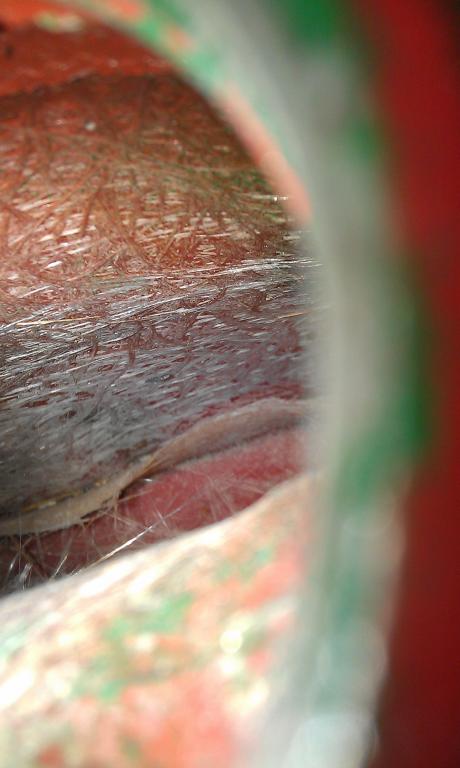
OK - like Italy, we (Australia) got 348s with fibreglass tanks so are very familiar with them. The steel insert for the cap is standard in the 348 fibreglass tank. I'm pretty sure you have the same fibreglass tank as what he have here, so if you want to have a look at the fibreglass, take the tank out in the sun with the cap off and let direct sunlight fall on the tank. If the cap tube limits things too much, find a bright light source and put it inside the tank while the tank is somewhere dark. If it has never been relined or repainted, you should be able to see the light coming through the walls of the tank, and that will show the pattern of the glass within the matrix. For info, here is a photo I took recently of the inside of a 1974 Sherpa T tank, before I relined it. The photo uses just the flash from the phone/camera. I don't have any photos showing the way the light penetrates the walls.

-
Do you mean Marzocchi forks or Cota 349 forks? If you mean 349 forks, I think I have measured them up previously and found they are a bit short - so the front of the bike would end up lower. You could probably find longer tubes though. The leading axle design of the 349 forks would require you to use the Cota 349 triple clamps to maintain suitable steering trail on the TY175. For heavier riders, the 349 forks would have a better action and spring rate than the TY175 forks.
-
Why are you not sure what the 1977 tank is made of? Can't you see inside? What do you mean "from Italy"? If it was made in 1977 it was almost certainly made in Spain and definitely made of fibreglass. Try and work out why the 248 tank is so heavy - it may have been lined and/or repaired, and if it has been relined it is very important to know what it was relined with if you are thinking about relining it again I would recommend getting the aluminium tank fixed and use it in preference to a fibreglass tank
-
Welcome tworivers It would help knowing what parts you need and where you live Also there is a wealth of this sort of information already in the Yamaha forum
-
Just thought of something else. If you are burning gearbox oil via a seal leak, the colour of the smoke is usually a lot whiter than the smoke caused by excess premix oil, or the burning out of gunk in the exhaust, which usually is pale blue
-
I also think it might be the clutch side crank seal, and if it is, the reason why it may still run and idle OK with that problem is that while it is sucking oil through the seal, it is not sucking air. I also suggest you check the oil level in the gearbox before riding it, to avoid the risk of damaging the gearbox. Also, worn rings don't cause exhaust smoke on a 2 stroke.
-
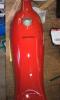
Here is what it ended up looking like
-
I'm just theorising here but if they had been stuck for a while, maybe they didn't seal too well to start with then improved as they bedded in When I have had them unstick, it has been the result of getting the motor much hotter than normal for a brief period, and I noticed the improvement in performance pretty much as soon as the motor was back to normal temperature, and so was able to identify the cause of the performance improvement
-
-
the fan is not unique to the Beta so seek alternate (economical) supply source - and is probably 12-24V DC. Definitely same fan as many other motorbikes and may also be the same as inside desktop PCs. Fan motor failure and thermostat (switch) failure are relatively common issues. I imagine that the fan motor cops a hiding if the fan blades get fouled up with something.
-
Sorry I don't have photos showing the airbox on that bike
-
-
Thankyou sparks2 and jon v8. I will post photos when done
-
OW10 Replica fuel tanks have been made in Japan in the past few years There is still at least one original OW10 in existence and it resides in France or Belgium and featured in a magazine story last year
-
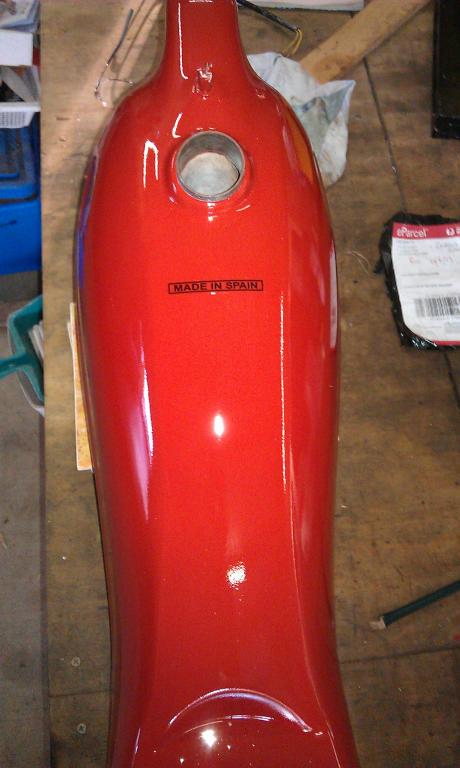
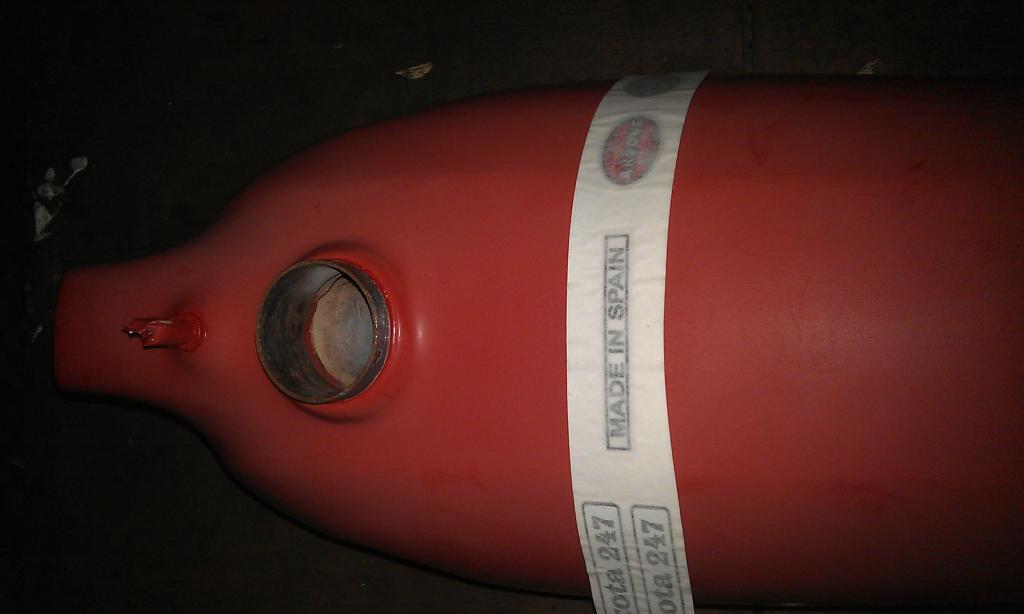
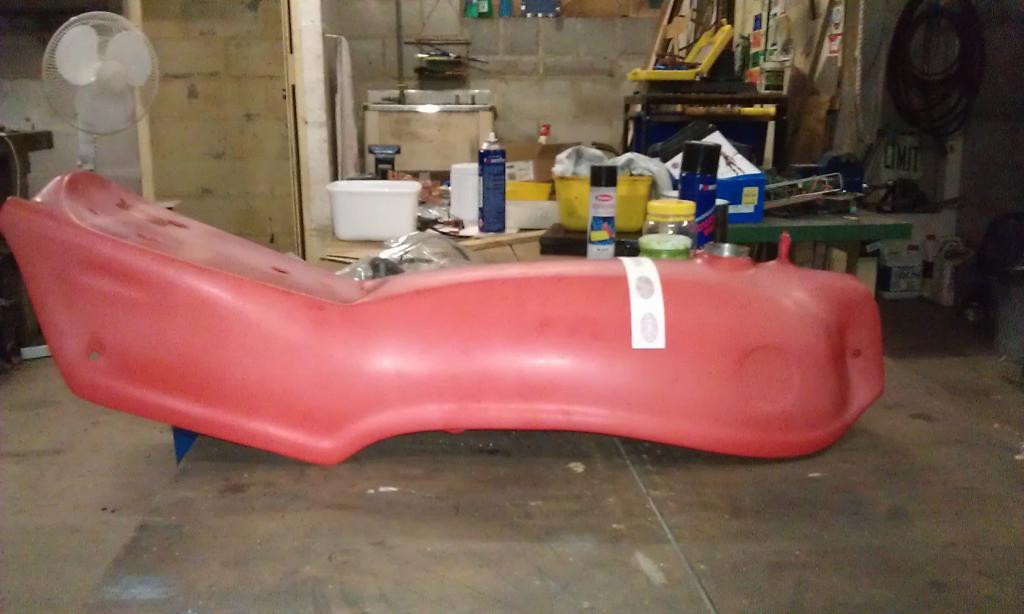
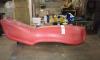
I'm helping a friend redecorate his Cota 247 tank and want to know where the "MADE IN SPAIN" decal was originally located. I have looked at every photo I can find in books and on the interweb and cannot find a photo showing the location of this particular decal. The owner thinks it should be about 50mm to the rear of the fuel cap hole but I want to make sure. Can anyone help please?

-
to suggest what to look for, more info is needed - suggesting a cause without info would be simply a guess what does the plug that comes out look like? (nose and electrodes) - can you do a decent close-up photo of it? what petrol are you using? does it run well when it is running? has it always had the problem? how long have you had the bike? how much use has the motor seen? has the exhaust system ever been cleaned out? has the motor ever been decoked? what is the ID on the plug are you using? are you doing a particular type of riding each time it cuts out?
-
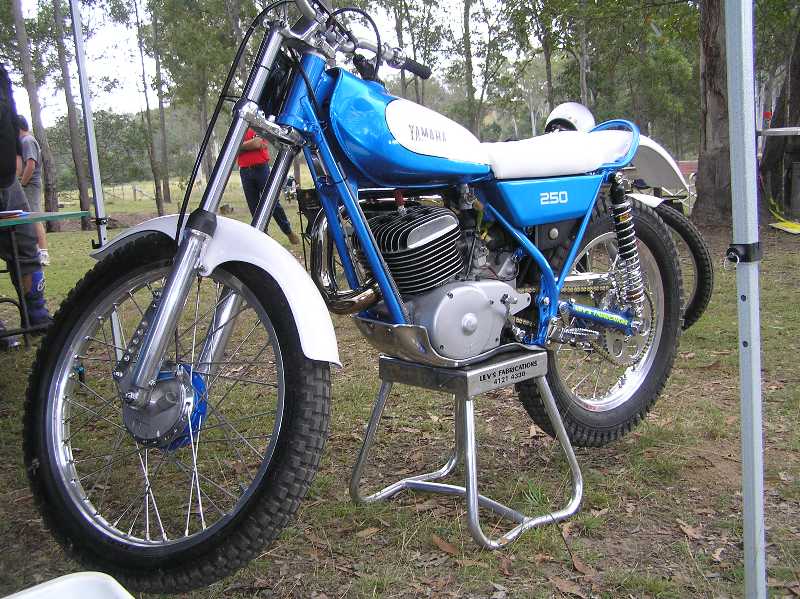
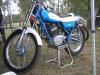
here's a nice custom job on a TY250B. If you can do red and black as good as this custom job you will be on a winner
-
http://roxspeedfx.com/category/atv-pivoting-risers.htm
-
Today I finally got the chance to work on the bike and found that there were two causes for the uneven running. The main reason was that the pilot circuit was blocked with oil. When I cleaned out the carby the first time, I was not looking for anything in particular, and didn't notice anything special. This time I was paying close attention and found that oil had entered the pilot air hole in the inlet bell of the carby, from the main air inlet tube. There was still quite a bit of oil in the inlet tube today. I suspect that the buildup was caused by the leaking reeds allowing blowback through the carby. The oil was the same colour as the premix oil I use (red/orange), while the air filter oil I use is blue. The tube has a dip in it halfway along which can act as a reservoir for the oil, and when I refitted the carby the first time without cleaning out the air inlet tube, more oil ran down to the carby inlet. What I found with the reeds was that they were still the same as when I put it back together a week or so ago (not quite sitting on the seats). Once I took the boyesen reeds off the cage, using a straight edge I could see that the rubber coating on the reed cage was sitting proud of the area where the reeds clamp to the cage, which was causing the reeds to curve away from the cage as the clamp screws were tightened. I checked two other TY250 reed cages which had been sitting dry for many years, and their rubber sections were less swollen than the one from the bike, but were still slightly proud of the area where the reed is mounted. I test rode the bike after cleaning out the oil problem, but before doing anything to the reeds, and found that while the motor ran much more evenly overall, at very low RPM and low throttle position, and under a slight load, it would misfire once about every 15 or 20 firing cycles. I then fitted a reed cage with standard Yamaha steel reeds, which sat nicely against the reed cage, and test rode again. I found that the idle air screw and throttle stop needed adjusting, but once set for the steel reeds, it ran without the misfiring at very low RPM and low throttle positions. From this I'm assuming that the boyesen reeds not seating properly was having an effect at extreme low RPM and low throttle opening, and may have also contributed to the oil buildup in the air inlet tube.
-
volume of a cylinder = pi x radius x radius x stroke. If you want the answer in ccs, use centimetres as your units of length
-
It helps to have the rear guard, seat and fuel tank off to see what is not right, so you can see the frame and the rear wheel. Old trials bikes have very flimsy swingarms and the arms can be bent sideways, or bent up and down relative to each other as sherpa325 says. The main section of the frame may also be bent, causing one swingarm pivot bolt hole to be forwards of the other hole.
-
The Yamaha development people in Holland developed a 360cc TY250 motor which utilised an RT3 barrel and head, and a stroked crank to achieve the same bore/stroke as the RT3 and DT360A motors. There was quite a bit of work required to achieve this with a TY250 bottom end. I have recently ridden a TY250D with this motor that was built in Sydney, Australia in 1977 using advice from the works Yamaha trials people in Holland at the time. It is still owned by the person who had it built in 1977, and it saw sterling service in both the solo frame and as a sidecar outfit. These motors are too tall to fit in a Majesty frame.