

konrad
Members
-
Joined
-
Last visited
Everything posted by konrad
-
I had no idea what the wheel sizes are for a TY80, but based on the eBay links above they appear to be: 16 x 1.40 15 x 1.75 Have you tried searching "16 x 1.40 steel rim"? There are results in the US. Seems likely the Chinese even make them. Edit: You would need the correct number of holes as well.
-
Technically interesting, but something I would not want to see in widespread use!
-
I have an opinion, but you're not going to like it. ONE OF THE BEST FEATURES OF ELECTRICS IS THAT THEY ARE QUIET!!!!!!!!!!!!!!!!!!! See, all that hollering is annoying. Yes, they are even quieter.
-
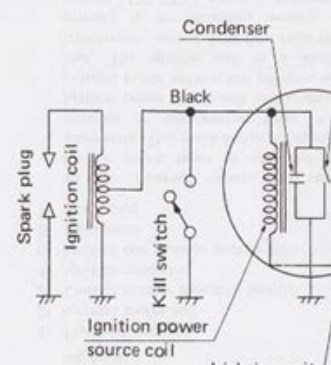
I'm not saying your coil is good, but oil won't cause it to short out. Lots of large transformers are cooled by being immersed in oil. Everything is in parallel with the source coil.
-
Which bearing did you decide was the possible issue?
-
The clicking sound is not normal. But it seems the repetition rate is too slow to be something in the gearbox. I'd look for something external like Zippy's problem first. Inspecting the drain oil is a good idea, but knowing the true history of the bike is more valuable. Did the prior owner sell because there was debris in the drain oil? Is there a chipped tooth somewhere? Out of curiosity, I looked for gearbox parts. It appears KTM is good about making GG parts available. You can buy individual gears and even a complete transmission assembly (MT40000CT-CSV-1) for $840 USD. https://trialssuperstore.com/products/gasgas-transmission-complete-19
-
I could not tell much from listening to your video at 1x, 0.75x, and 0.5x speed. I think a better diagnostic would be to video the bike running on a stand in 4th (probably would have to load the motor by using the back brake) and slowly letting it rev. Note that both 1st gear and 4th gear use three gear-pairs to transmit power though the box. So the whine should be similar for 1st and 4th. There is a large ratio change between 4th and 5th, and this will make a clunk and not be smooth. The farther apart the ratios are, the more pronounced this will be.
-
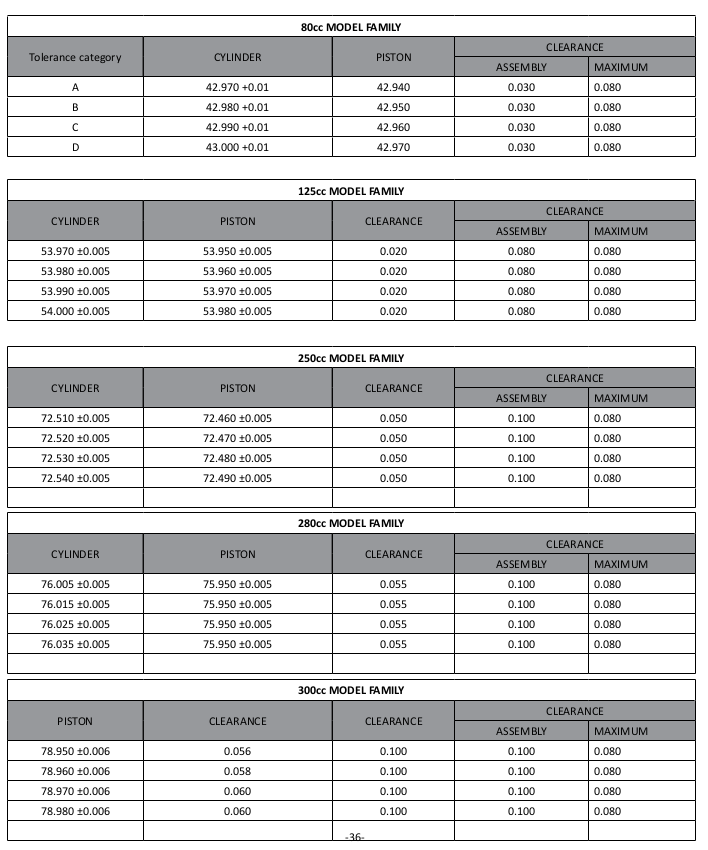
At first, I was going to say the "assembly" number is the service limit. But viewing that table in the context of the other displacements, it makes no sense at all. It's a horrible table!
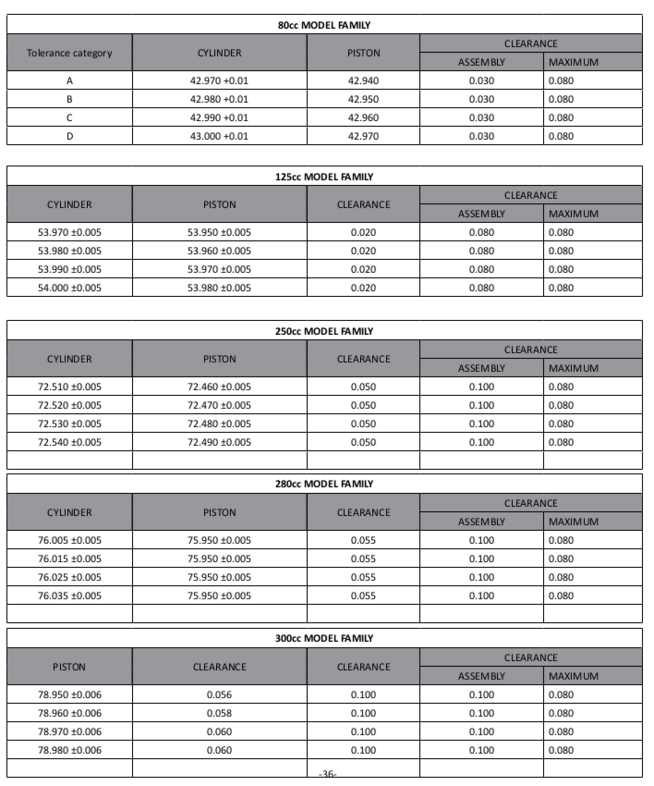
-
That's a very nice manual! Anyone learning to do maintenance on a trials bike (regardless of brand) would be well-advised to study it. Unfortunately, there is almost no content about the gearbox (see page 49).
-
It should NOT sound like it's going to blow up! But 4th gear is "complicated" and actually requires 3 gear pairs to create the ratio. Here is a link to a YouTube video that demonstrates this, as well as the original GG patent in Spanish: https://www.electricmotiontech.com/home/em-factor-e/clutch-gearbox#h.2ajazdf2rs5
-
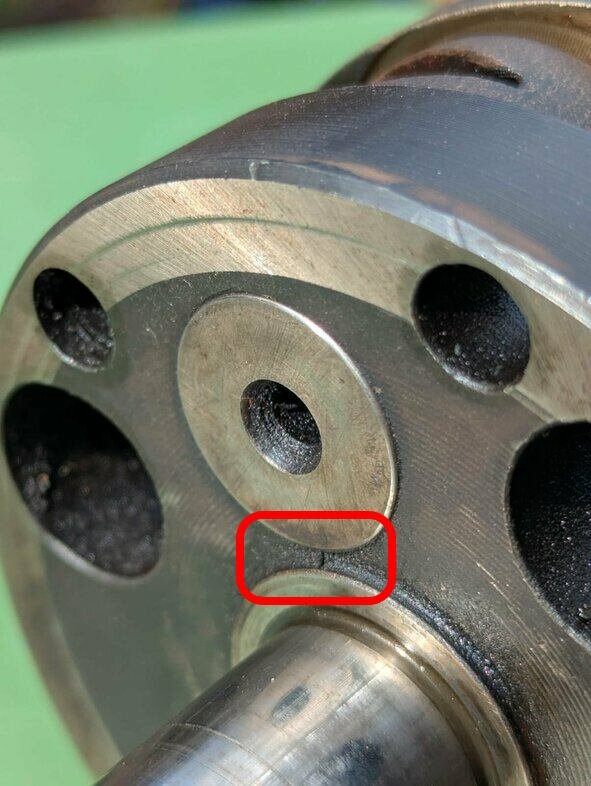
Can you feel anything with a sharp-tipped scribe? A crack could explain the problem you are having. Another thing to consider is the history of the crankshaft. After repeated pressings, the pin/crankwheel interference fit can become too loose. If you have a dial indicator and a means of supporting the crankshaft, measuring the runout could tell if the crank wheels have shifted position,
-
-
I think this relates to your prior post about huge side-clearance on connecting rod. I have read about the washers on the piston pin, but have never seen a motor that used the technique. What struck me as odd, is that the big-end bearing itself seems to have a lot of clearance to the crank wheels and could walk from one side to the other. So, even though that motor may use washers on the piston pin for rod centering, it may still be that the crank wheels are too far apart. But this is all speculation on my part. I don't work on "antique" motors.
-
Ciao! I think you should start a new thread describing technical details of your installation. Many of us would find it interesting. I would be curious to know: Had the old controller failed? How often does the controller's fan run? How did the performance improve? How long did the project take? Total cost? What seat is that? Did you upgrade the battery also? I see a clutch lever. How does that work?
-
After a seizure, the piston probably must be replaced. If the seizure was very light, it's sometimes possible to sand a damaged piston smooth again. But if there has been any aluminum transferred to the cylinder, sanding is not advisable. Furthermore, if any rearranged aluminum has impinged on the ring lands, the piston must be replaced. If the cylinder damage is just aluminum transfer, it's possible to remove the aluminum with hydrochloric (aka muriatic) acid. But, if any peeling of the plating has occurred, the cylinder must be re-plated. Sometimes imperfections in the cylinder plating are tolerated in areas above the ring travel or below the piston travel. Note that Nikasil plating is very hard, and a diamond hone must be used. A standard cylinder hone for iron won't work. It's probably not possible to determine the extent of seizure damage from photographs. If in doubt, a local specialist should be consulted. But finding OSSA parts is not easy either. ☹️
-
This link shows the many Lifan engines produced: https://gzbawo.en.made-in-china.com/product-group/lqKanTtOOzcr/LIFAN-engine-1.html Search in your own country, but this is an example from the USA: https://www.amazon.com/CUBELLIN-200CC-250CC-Motor-Engine/dp/B0D81ZTJDH
-
You are probably not going to find much information about that enduro bike (?) on a trials forum. It appears to currently have a Lifan motor (which is a Chinese copy of the Honda XR100). Lifan built them in a variety of sizes up to about 200cc. You can measure the bore and stroke to determine its displacement. Have you considered that it will cost more to repair that bike than it will be worth?
-
Unfortunately, it likely seized. Start by draining the coolant and removing the head to inspect the cylinder wall. It's possible to remove the cylinder and piston as a unit without removing the engine from the chassis. Of course, you must first remove the piston pin.
-
It's certainly possible, but will require technical knowledge. The best place to learn about building small lithium-ion batteries is a forum devoted to electric bicycles. Lead-acid batteries have an energy density of 30-50 Wh/kg and specific energy of 20-50 Wh/L. Compare this to lithium-ion batteries, which presently have an energy density of 150-200 Wh/kg and specific energy of 250-670 Wh/L. The improvement will be dramatic!
-
There is an axiom from motorsports that success in auto racing is 75% car, 25% driver. In motorcycle racing, it's more like 25% bike, 75% rider. I would venture a guess that in trials it's 10% bike, 90% rider.
-
As much as I'd like to help, it has never been my intention to give detailed troubleshooting instructions. There are a variety of reasons for this. You will probably need to fabricate the JST JWPF pick-off connectors described on my website. My advice is to find someone local who can assist you or perform the work.
-
It's possible there is a fault in your wiring harness and the enable signal is not making its way back to the controller. There's good documentation here: https://docs.silixcon.com/docs/hw/esc/sc1/Wiring and here: https://docs.silixcon.com/docs/hw/esc/sc1/IO Bear in mind that the EM controller does not use the flip-flop function for enable. There must be constant battery voltage on the controller's "POWER" input to allow it to operate. Be mindful that there is a non-replaceable fuse inside the controller. Don't short the "KEY" pin to ground (that's why an external resistor is recommended for current limiting).
-
Based on your prior description, I assumed you had the 2019 model year. That is the first year EM used the siliXcon controller. The wiring diagram will be very similar to the Epure bikes: https://www.electricmotiontech.com/home/em-epure-race/wiring-diagram No startup tones would seem to indicate the controller is not being enabled. Did you bypass your "Security Magnet" (kill switch) as I describe here: https://www.electricmotiontech.com/home/em-epure-race/wiring-diagram#h.fogcawtque8h
-
I'm going to agree with lemur on this. @JBROWN asked about the "POWER BOX" in a different thread. I found a Vertigo service manual on-line. It's probably similar to what you have. The mechanical descriptions are very good. The electrical descriptions are the exact opposed. The part labeled POWER BOX has a 12-wire connector. It is separate from the ECU. I'm thinking the ECU may be a fairly standard design for 4-strokes. If so, the POWER BOX may add a Capacitive Discharge Ignition and DC-DC boost converter. A CDI is de rigueur for any modern 2-stroke. Twelve wires is a lot for that type of functionality, so the POWER BOX may be doing other things as well. I suggest figuring out where the ignition coil primary wire connects. The lack of a wiring diagram is a huge impediment to understanding the system. You'd be doing the Vertigo community a great service by drawing as much of it as you can and putting it in the public domain.
-
The electrical system on an EFI bike has very little in common with even a modern carbureted bike. Even though my website is specifically about OSSAs, there is a lot you can generalize about EFI 2-strokes from it: https://www.ossa-efi.com/home/electrics At the very least, it will give you an idea of the complexity involved.