


dan williams
Site Supporter
-
Joined
-
Last visited
Everything posted by dan williams
-
The sheared woodruff key is very common in these situations. Having the primary gear spin off is not something I’ve heard before. Learn something new every day. ?
-
Would be nice if they didn’t look like they were hogged out with a hammer and chisel.
-
If you look at the 2017-2018 engine service manual it looks like these are intentional oil passages. https://www.betausa.com/sites/default/files/pdf/trialsservicemanuals/2017-2018 Evo 2 stroke engine service manual .pdf
-
Could be too much preload on the rear. The front and rear suspensions need to work together and if they are unbalanced the geometry will change in unpredictable ways as the bike responds to terrain and input. The other thing that makes the front seem to be pushing is bad technique. You steer a trials bike with your feet. By that I mean pressure on the pegs and bending your knees to stay centered. Most riders especially ones coming from enduro bikes have the bad habit of keeping their legs too straight. To compensate they twist their torso and throw their ass to the side. This is a very weak position as there is no way to compensate for variations in speed caused by the terrain. Beta's are especially unforgiving of this. They also reward good technique with being able to turn inside almost any other brand. If you can ride a figure eight on a hillside and stop and balance at any point in the figure eight you are doing it correct. If you find yourself constantly dabbing on the inside of a turn you are riding with your legs too straight. The best way to demonstrate it is to stand on an incline perpendicular to the fall line (facing across the slope). The natural stance is to bend the uphill leg and straighten the downhill leg with your weight evenly distributed. This is exactly what your stance should be on a trials bike during a turn. Shoulders level and weight centered over the line between the contact patches of the tires. As you lean the bike the inside leg/arm straightens and the outside leg/arm bends so the body position doesn't change. That's critical. No leaning into the turn because as soon as you dip a shoulder you're in a much weaker position. Try the same standing on a slope experiment and straighten your legs and pay attention to how you have to rotate your torso and counter balance with your butt. Have a friend knock you off balance in both positions and you'll see how much stronger you are in the proper stance. It takes practice to make it habit but once you start to get the feel of staying centered you'll be able to turn that thing like it's on rails.
-
Couple of things with Beta steering bearings. Because of the aluminum frame they tend to take longer to seat so often owners will crank down on the retaining ring to get rid of the front end clunk that develops. This is usually a short term thing as the bearings eventually seat after a few small adjustments and time on the bike. The other thing that is a problem is the top triple clamp before 2018 has no pinch bolt on the steering stem. On every Rev3/EVO I owned before the 2018 the top triple clamp stem hole was machined just a few thousandths too big. I'm sure it made for easier assembly but it also introduced a clunk in the front end that took me months to find. By tightening down the nut above the top clamp the clunk will go away for a short bit but it will return and eventually you can strip the threads on the steering stem. The best solution is to shim the hole but it's a bit of a pain to find the proper material. I used to use Teflon pipe tape wrapped around the stem and trapped between the top clamp and nut. It would stay for about a year before getting compressed and having to be redone. On the last bike I had with this issue I got some brass shim stock and made a thin sleeve to shim the steering stem. That's held for several years now..
-
Good luck and let us know how you do. I'm sure you'll have a great time.
-
Typically this is a titanium nitride coating which is intended to reduce seal stiction. If the forks are properly aligned then the effect is pretty small. More importantly you should ask to pull the water pump cover off and look for corrosion of the case.
-
You'll get it in time. Right now your conditioned reflexes are tuned to the bicycle but with practice you will develop a new set. You can't force it since you are connecting neural pathways. Time and practice.
-
Yeah I think he just needs a break.
-
You're doing the right thing. Only way to have peace of mind is to tear it apart and be certain but as thall says the most likely is the throttle cable and once it's reseated it's like a little kid saying, "What? Me! No I didn't do it.". Ignition can't hold the throttle open and the engine won't rev without access to a lot of air so I'd not bother with that line of investigation. One thing that seems counter intuitive when this happens is to grab the throttle and pin it to full for a split second. It often seats the cable allowing the engine to come back down. Of course when it's revving its nuts off that's the last thing that comes to mind but it often works. As for grabbing the spark wire I'll let the thing explode before I ever do that again. I'm rather fond of my heartbeat.
-
Gotta be a throttle cable pulled out as noted above. The only other possibility is a split open intake manifold or debris in the carb to hold the slide open. If it was a relatively short term event the bike may be fine. The damage to the owner is severe. If the bike runs OK there is most likely no damage to the top end as the chrome bores are pretty resistant until the piston actually starts fusion welding itself to the bore. If you still have normal compression your rings are not stuck (first clue of a seizure) and you probably dodged the bullet. Best to get into the habit of twisting the throttle before you start the bike and making sure there is a good solid thwock sound from the carb when you let go. Not only is it reassuring but it seats the cable.
-
As many as possible. I’ll work the first one and may work one of the Vermont days because they are always looking for checkers. The July event will be pulled from the schedule as the club has cancelled.
-
Not sure I’d call that clean. Also that’s one of the 3mm thick plates. I take those out and replace with the 2.7mm thick plates on the 2T. What’s that groove in the pads? I’m out of the 3mm spacers I had made so I can’t send any to you.
-
Well yes and no. The CDI has a microcontroller in it that looks for a trigger signal. If it see a pulse in the wrong place or just one when its expecting two it's entirely possible for the CDI to get confused and fire at the wrong time. Unless your stator plate is rotated far from where it should be I think you have a bad trigger coil and the CDI is just doing the best with what its got for a trigger pulse. You're correct that there is no real help from Beta for determining how good the stator/CDI is working other than the thing runs.
-
Either a floating ground, scrambled wiring or stator as it's the trigger coil that goes when the stator gives up the ghost.
-
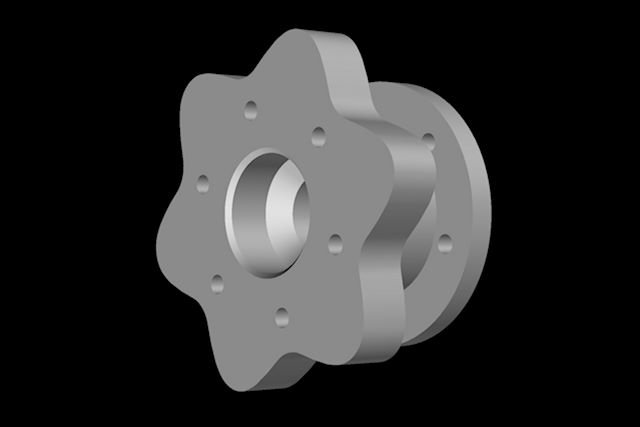
It's winter here (single digits F) and I don't have a heated garage so the short answer is no. Plus I screwed up the jig I had for drilling the extra holes when the chuck on my cheapo drill slipped. The drill bit bound in the hole and bent the drill bit ever so slightly which I didn't notice until after I drilled all the holes, reaming out the locating jig I made and pooching the spare indexing cam I bought. Made me step back and reassess the plan. Then real work intruded and I haven't got back to it yet. I do have a second jig but I've been considering taking a different tack. I've got most of a cam drawn up in eMachineshop and the cost to have custom cams made isn't too bad so I might just forgo the drilling and design my own cam with a custom profile. I'm leaning towards a steeper cam angle with a flat top. Like the older Japanese bikes where there is more resistance to the initial rotation but no resistance once up on top of the flat between gears. This would take a bit more effort to shift between gears but make it more positive once a gear is engaged. I think this is what gives them their "snicky" feel. I'd also go much shallower on the neutral notch. Unfortunately with the cam sitting in a case well and having to fit under the clutch basket there's not a lot of room to play with dimensions. This is just the initial drawing so no modified profile or neutral notch. Or indexing holes.
-
Here's what I have from the annual New England Trials Association meeting yesterday. I'll correct as I get more info. April 14th RITC Trials School Exeter RI. May 5th King Philip Trail Riders, Trials Wrentham MA. Wayne Galvin May 19th Meriden Motorcycle Club, Meriden CT. June 9th Springfield Motorcycle Club, Brimfield MA. Leo O’Shea June 23rd Stateline Riders, Hoosick NY. Max Parkes August 11th RITC, Exeter RI. Sept 7th & 8th Green Mountain Plonkers, Richmond VT. Denver Wilson, Tom Butland Sept 22nd RITC, Exeter RI. Joe Antonelli Sept 29th Meriden Motorcycle Club, Meriden CT. Oct 12th & 13th CATRA, Northville NY
-
Eeeek! No, that won’t work. I’m sorry I didn’t realize you had one of the Jitsie accessory screws. I thought you had the original screw that came with the carb. I tried one of those on my 2013 EVO and ran into the same problem. http://www.carbparts.com/keihin/pwk28parts.htm parts 17 and 18
-
There is a certain sense of satisfaction hearing the placebo switch click and feeling like you've done something. Actually I think it only affects the mapping at high RPM and since I spend so little time there it makes no difference to me.
-
Ryan Young used to have an excellent video on changing fork seals on a Sherco with the Paioli forks. It's worth a watch if you can find it.
-
Just wanted to add something that happened with a Keihin on a GasGas. Bouncing the front gagged and sputtered the engine and was very like the issues mentioned above. Turned out the choke was partially on. So while trying to diagnose the bounce sputter issue I had never considered a leaky choke circuit. So if your bike gags on downhills or while bouncing the front end have a look at your choke valve.
-
What happens when you turn the idle up is you are not running on the pilot circuit anymore so the mixture screw does practically nothing. I have used the extended cable air screw as well as the regular flat blade type air screw. I'm pretty much convinced it's better to just use the regular screw without the cable and make a couple of long thin flat blade screwdrivers for adjusting the mixture screw. The cable screws are just kind of a pain. If the carb is clean and jetted properly I'll adjust the screw at the start of the day for temperature and the bike will run fine all day. If the pilot circuit (not just the jet) is blocked I'm chasing the mixture all day and it never feels right until I clean the carb.
-
I remember seeing them years ago on the web but not for a while. When I do the disassemble and clean on my carbs I'm real careful. They may be impossible to source now.
-
The Keihin on your bike is notorious for plugging the pilot circuit because the passages are really small. As lineaway said, pull the carb, disassemble and blow it out with compressed air being careful to not force too much pressure through the body. There’s a couple of sealing rings in the Keihin that are damn near impossible to source if you damage them. I find I have to do this routine about twice a year.
-
If you don’t ding the stanchions you should get years out of a set of seals. You need to do a careful visual of the tubes. If you have a nick in the tube no seal will last very long.