
konrad
Members
-
Joined
-
Last visited
Everything posted by konrad
-
I did not realize Scorpa was making those in 1995. Can you post a picture of the engine? The 175cc 4T Scorpas I've seen in the USA were based on the Yamaha TT-R125. But the TT-R was not introduced (here at least) until about 2000. I've owned several TT-R125s over the years. They are excellent engines and easy to work on. The Chinese pitbike motors were patterned after Honda designs.
-
Well, that makes you the perfect EFI OSSA owner. Congratulations on the rapid repair. Thanks for giving feedback.
-
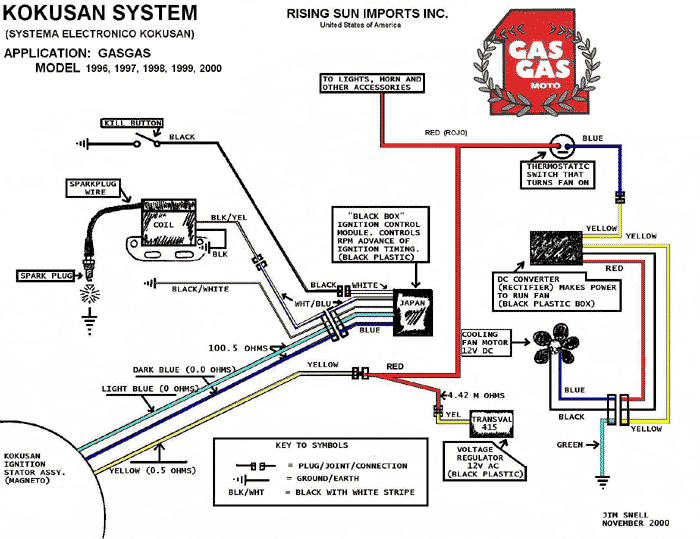
That was my first trials bike. I have attached Jim Snell's wiring diagram. Pretty sure I had to replace the thermo-switch at some point. Best way to test the fan is by connecting it to a 12-volt battery. The regulator (Transval) is probably a Zener diode clipper. Remember that any voltage you measure without its load (fan) will be somewhat higher than when it's loaded. The thing Snell calls the DC Converter is just a bridge rectifier. Here's a YouTube on how to test it.
-
The somewhat flippant (but accurate) answer is: When the ECU tells it to. Removing the pump is a total PITA. I strongly suggest you test the pump with a 12-volt battery connected to the bike's diagnostic port. A 2014 Explorer will have the 6-pin diagnostic connector. See: https://www.ossa-efi.com/home/pc-software/diy-diagnostic-interface Just connect a battery to the Batt+ and Batt- terminals shown. The pump should run for a few seconds each time the battery is connected. Eventually, you will want/need to build a complete diagnostic cable.
-
The AAA-cell (Easy Start) won't run the fuel pump. You need 12 volts to do that. https://www.ossa-efi.com/home/chassis/fuel-pump Wiring diagrams are on the website as well.
-
At a minimum, fork seals seem likely: https://www.splatshop.co.uk/fork-oil-seals-40x52x10mm-marzocchi-each.html
-
Regarding the steep deprecation, Mecatecno has a "radically different sales philosophy" than Electric Motion. At least privately, Mecatecno is claiming that it will always be possible to update the electronics and every part and accessory. They feel this is key to their approach and a strong sales argument to share. I guess we will see what the future holds.
-
I'm assuming it's a tapered roller bearing. The 32004 has a 42mm OD, a 20mm ID, and a 15mm width.
-
Two different manufacturers. Seems unlikely to me. Post some photos of your Olle internals. What is the distance (completely unweighted) from the center of the axle to the top of the stanchion? Where would you buy Marzocchi internals anyway? A complete fork swap seems more doable. Or are you asking if the fender, caliper, and wheel will swap over? That is very likely to be a bolt-on operation..
-
I've never done a GG, but the EFI OSSA gearbox is similar (designed by the same guy). It's a goofy (patented) mechanism for sure, 4 gear pairs provide 6 ratios. Here is a service manual for the 2018 bike, which will have a similar transmission setup. See page 48, everything is held in the right hand case-half. https://drive.google.com/drive/folders/1xOzbrZQDO_W_AxpjvHU1xJMOqfRsVfPJ
-
Just added a section to my website on identifying model years based on VIN and motor number. See it here: https://www.ossa-efi.com/home/factory-documentation/model-year-identification I would love to gather more examples, and possibly even create a registry of where bikes are roughly located. If you don't want to share your complete VIN, even the 10th character would be helpful. Likewise for the motor number, the two characters after the "I" would be helpful. I'm especially interested in finding examples from 2015. Feel free to contact me by PM.
-
That is really good advice! Here is what I know about the clutch: https://www.electricmotiontech.com/home/em-epure-race/mechanicals/clutch
-
Talk to your importer. A friend with a '22 thought his shock was bad from Day-1. You may be able to get a good price on a replacement.
-
Yes, that works to remove the left-hand locker shaft nut.
-
So does this make you a fixer shaft fixer? 😉 Although getting the old bearing out is somewhat difficult, getting the new bearing back in is even more difficult! Lots about it here: https://www.ossa-efi.com/home/engine/gearbox/locker-shaft
-
2024 Vertigo? I thought there was an EU ban on exporting motorcycles priced above €5000 into Russia. Is that no longer in effect?
-
So the body itself has a damaged thread? This part won't fix it? https://www.splatshop.co.uk/dellorto-float-bowl-nut.html If not, can you run a tap into the body and clean it up? Here's the entire carb with the BS suffix (your jetting may be different) https://www.splatshop.co.uk/dellorto-phbl-trials-carburettor.html
-
Ask ten guys and you will get at least that many different answers. 😀 You may want to consider your first trials bike as just a learning exercise. Only after gaining some experience will you understand what works for you. If you are actually going to compete on the bike (as opposed to just riding it casually) then repeatedly starting a 250 may become quite taxing if you have physical limitations. Wearing back support is a great idea. Any trials bike can be made more comfortable by fitting bar risers.
-
The Beta 80 I worked on had 21" / 18" wheels. I think that's what is meant by "big wheel" or senior.
-
I spent several hours riding a 2006 Beta 80 while attempting to improve it for an early-50s petite female. I still have the notes. On the plus side, the biked weighed 146.5 pounds with a half tank of fuel. The wheelbase was only 49 inches - that's 3 inches shorter than a typical trials bike of that era. Turning was extremely good. It was super-easy to kickstart. On the minus side, the engine was a bored-out 65cc KTM as used in their kid's MX bike. It used a very heavy flywheel and tiny carburetor to try and give it a trials feel. But it still had an expansion chamber type exhaust system. It ran like a detuned MX bike, not a trials bike. I even reshaped the combustion chamber in an effort to improve it. The gearbox ratios were also not well suited to trials. I needed to ride it in 3rd gear to have any reasonable ground speed, but then it lacked rear-wheel torque. It might be a suitable bike if you are very light and don't really have any other off-road experience/expectations. I would suggest you try before buying and also try a 125. A more modern Beta 80 may be completely different.
-
Also, The Hell Team's notes say 14mm thin wrench. My thin wrenches are Imperial and one was a perfect fit.
-
It should come apart easily. I would use a thinner 15mm wrench. Buy a cheap tool and grind it thinner. Do you have the same problem with the other side? Gentle heating always helps. Lots of Marzocchi info here: https://www.ossa-efi.com/home/chassis/marzocchi-forks
-
In John Robinson's 2T tuning book, he classified an oil's load-bearing capability based on the results of Falex and ZN wear tests. In addition to two modern oils (Motul 800 and Silkolene Pro 2) the highest-rated oils were castor based. So for engines having the very highest specific power outputs (e.g. road racing) using a castor-based oil is not completely foolish. But a trials bike does not fall into that category. And castor's drawbacks are, as mentioned, quite a nuisance. At one point in my life I was very interested in the chemistry of combustion. I reasoned that castor oil could also act as a chemical supercharger since it is an oxygen-bearing fuel.
-
Beautiful restoration work! Same goes for your RTL250F. Will you ride these bikes? Or are they just for show?
-
That's what I would do. Thinking more about it... I use a synthetic ATF in the gearbox because I like how it makes the clutch feel. But clutch feel would be less important on the Explorer than a trials bike. Might be smarter to use a high-quality gear oil since the gearbox is so fragile.