| |
-
Neo I hope I've beaten Maree to this one.
I couldn't resist asking have you ever fitted Bach Busters to your Handel Bars?
AFAM bars are quite crash resistant as far as 7/8" bars go and nice ergos too.
David Lahey
-
Aussie Bultaco fanatic Paul Paterson was given a very nice birthday cake.
http://www.trials.com.au/phpBB3/viewtopic....;p=14851#p14851
-
I hope they do make new OSSA MARs again. They are very nice to ride. Yes that OSSA my wife was riding in that photo still runs. I fact it runs and rides like a dream. Here is a more recent photo it and having the M49 in the photo probably makes it a legit photo for the Bultaco forum.
-
Sorry its not a Bultaco but its closer than a Beta or a Yamaha and I didn't have to stage a photo. I had forgotten about this photo which was taken in about 2005.
-
Even with road pressure, competition trials tyres are terrible when you lean the bike in a turn due to the squareness of the tyre profile.
To answer your question, 14 psi front and rear is usually enough to prevent overheating the tyres at high speed on bitumen.
-
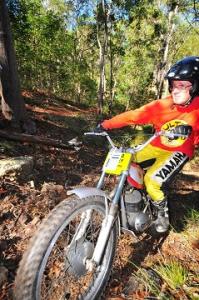
I could post a photo of my wife riding a trials bike - the only problem is that the only photos are of her riding Yamahas and Betas and this is the Bultaco forum! Sounds like a good excuse to get a Bultaco out for some photos.
-
quote name='Greeves' post='199498' date='Apr 20 2009, 10:10 AM']At last it will cost you a lot of money in romantic dinners, operas, romantic comedy movies, visits to your in-law family and all this sort of boaring things that wifes enjoy to do if you want them to live a live in peace with your classic bikes (our real and true loves).
Mine looked dissapointed when I told her she should use Castrol TTS better than the perfume she normally uses.
Hey Greeves my wife read your posting and thinks those romantic things you do with your wife are a great idea. Thanks mate.
I thought I was going OK with her till now.
-
Do you mean the DT200 (water cooled 1987 - mid 1990s), or the DT175 (air cooled and same motor from 1978 to whenever they stopped making them some time in the late 1990s)?
-
-
Alan springs are rated by the amount of force it takes to compress them a certain distance. Common units are pounds per inch or newtons per mm.
You should probably aim for two things with your TY250 springs:
Shockies approx 40% to 50% compressed with you aboard and balanced
With no-one on the bike, the rear suspension should sit almost topped out (about 5mm from the top)
The sequence to use is to set the preload to give the 5mm static sag and then see how far they compress with you on board. The ones that compress 40% to 50% with you on board are the best.
The rebound issue you mentioned is more likely to be a problem with a lack of rebound damping than with the spring rate.
About the relative stiffness of your springs, spring rate (stiffness) is proportional to the wire diameter, but it is also inversely proportional to the total length of the wire (coil diameter x pi times x number of coils).
Wire diameter up - stiffness up
Coil diameter up - stiffness down
Number of coils up - stiffness down
If you want to work out what rate your springs are, just google spring rate calculation and you will find a formula to use.
Some shockies damping works with the shockies either way. Some work only with the rod at the top, some only with the rod at the bottom. If you test them by hand with the springs off, you should be able to tell what is happening.
-
Yes I use the 125mm oil height method
5WT for oil is too light for those forks (they are not cartridge forks)
15WT or 20WT is more likely to be what you want
-
You probably have a crankcase air leak by the sound of it.
Check the cylinder base gasket for leaks and the gasket between the carby and the inlet tube, unless it has a hose in which case check the hose for cracks.
You have probably checked but haven't said that fuel is getting into the float bowl.
Make sure there is no bung missing from the bottom of the crankcases (some bikes have a bung to let water out of a drowned motor)
-
Yes the crankshaft should be able to move within the bearing inner ring for thermal expansion so don't use Loctite bearing mount on it. Just because the bearing seat on the crankshaft is scored does not mean it will be a problem, provided any raised sections are removed.
I would be concerned if there was scoring where the seal lips run as that would wear the seal lips out in no time.
-
Front mount bolt is M8 and has no bush in the motor
Top rear bolt is M8 and has a rubber bush and steel sleeve inside the rubber bush. Both go right through the motor casings and the frame lugs should clamp to the steel sleeve.
Bottom rear with welded on nut - I couldn't see with the motors is situ if they are M8 or M10, but there is no bush in this lug.
I wouldn't be surprised if someone had made some of the holes a bit oversize because the TY175 frame does move out of shape with use and unless it gets pushed back in shape after taking the motor out, the holes don't line up when reinstalling the motor in the frame.
-
TY250 twinshock springs are close to being coil bound when the forks bottom with the standard springs and spacers. If you add more than about 9mm of additional preload, you will get coil binding, which limits travel, and can bend the springs.
I see someone advised not bothering with heavier fork oil to prevent bottoming. I would like to suggest that heavier weight oil will reduce the bottoming, as will reducing the air space on top of the oil.
I suggest you add a modest amount of additional spacer length say 5mm, and carefully set the fork oil height to 125mm from the top of the tubes, with the springs removed and the forks completely bottomed. 15WT or 20WT fork oil will be fine.
If you still are not happy with the bottoming resistance after doing these things, springs with a higher rate can be bought from B&J Racing in Tennessee.
On another note, TY250 twinshock forks have effective anti-topping springs and will remain free of harsh topping out provide the forks have enough oil in them to provide rebound damping.
They also have a very effective anti-bottoming hydraulic device so will not bottom metal-to-metal during riding provided there is enough oil in them to cover the device.
-
Adjust the pushrod till the cable makes a 90 degree angle with the arm at mid travel
-
You may have bent the crankshaft while changing the crank seals in which case the knocking is the primary gear mesh running out of clearance and then when the nut jammed in the primary drive its possible that you may have bent the gearbox shaft.
You should be able to tell if the crankshaft is bent by taking the spark plug out and turning the motor over by hand, feeling for tight spots. If there are tight spots then the primary drive mesh is running out of clearance. If the tight spot is once per revolution, the crank is bent. If it is once per clutch revolution, then it is the gearbox shaft that is bent and you may even have a combination.
Having the nut jam in there may also have deformed some of the teeth on the clutch or on the pinion, which can also make a knock.
-
US bike magazines often ran trials bikes on a dyno as part of a testing for magazine articles so you may have luck getting torque and power curves by looking for old magazine tests.
I remember the Aussie magazines had a thing for it in the 1970s too and one such comparison in Trail and Track mag put both the Suzuki RL250 and the Yamaha TY250A curves on the one chart for comparison. The RL250 motor performance was well above the Yamaha in the mid RPM range and was about the same at top and bottom. I don't actually remember ever seeing a curve for a Cota 348. If you are keen enough, just put yours on a motorbike dynomometer and get it tested. I'm sure we would all love to see the result.
David Lahey
-
Belldane, I think you are mixing up the terms "low down torque" and "torque".
Torque is a moment about an axis. Units of torque are force times radius as in newton-metres or foot-pounds. Internal combustion engines produce a range of torque over the operating RPM range. Motors are designed to produce their torque peak (and how quickly it drops off on both sides of the peak) at an RPM range suitable for the purpose. If a motor generates good torque at low RPM, then it is comonly referred to as having good low-down torque. People commonly leave off the "low-down" bit and call it a torquey motor.
Power is torque times RPM or newton-metres times radians per second, or Watts. The RPM where peak power is generated is usually higher than the RPM for peak torque.
A Cota 348 produces its peak torque about where Wayne said and its peak power at slightly higher RPM. The important performance characteristic for any trials motor is that the torque curve is relatively flat, compared with a racing motor. Motors are commonly described as "peaky" if they have a sharply rising and falling torque curve. The Cota 348 has a lusciously flat torque curve.
David
-
Head aluminium
Cylinder aluminium with ferrous liner
-
And here is what a 348 gearbox breather looks like (small shiny hole). Photo taken fron underneath
-
I think that a more common carby replacement for the 348 would be to a Mikuni, if only because so many people are already familiar with jetting Mikunis.
-
By the way, the cream colour of the oil means that it is doing its job of preventing water contacting metal. The properties of the oil cause water to be broken into microscopic droplets (surrounded by oil) so that only oil is in contact with metal parts.
-
I'm never surprised at what comes out of a second hand bike gearbox. One 348 I bought had forks that didn't move up and down. When I took the caps off I found why - they were completely full of water (the air valves had let water in from rain and the forks were jammed from the steel bits rusting up). As well as that someone had fitted fork spring preload spacers so long that the springs had been coil-binding severely and been ruined in the process (bent springs).
348 and 349 gearboxes do have breathers, but they don't have hoses on them to reach above water level! Have a close look at the rear of the gearbox casing about where the swingarm pivot is and you should see a little hole there which is the breather. Another 348 I bought had that hole sealed up with araldite (and no other way of preventing pressure/vacuum issues within the gearbox)
-
There probably should be a heat shield in there to protect the fibreglass, but they came standard without a heat shield. My exhaust is in contact with the fibreglass, so I suspect a shield or lagging would have to be quite thin to fit in there.
|
|