
feetupfun
Members
-
Joined
-
Last visited
Everything posted by feetupfun
-
Alan, the B, C and D model flywheels have an even bigger external steel band on them than the A model. I've ridden them with and without the band and find that while they are quite zippy with no band fitted, you need to have a very quick clutch hand to avoid stalling when riding serious dry rock sections. I have ended up with steel bands that are about 2/3 the size of the B,C and D model bands (or 3/4 the size of the A model band) on my B and D model motors. David
-
200 may be OK depending on altitude and if you do road riding or not. When my TY175 was 175cc and was being ridden only in trials sections, I found that a 185 main was just the ticket. If you do a bit of sustained high speed, I wouldn't go much leaner than a 220.
-
Standard they have a steel band fitted to the OD of the magneto flywheel. Are you saying that yours has a weight fitted to the face of the magneto flywheel as well as the band on the OD?
-
I'm not saying it is a blocked pilot jet, but to answer your question, a bike with a partially blocked pilot jet may run and start OK when warm, but not start cold, because motors need a richer fuel/air ratio to run when the metal parts are cold than they do when warm. If you have the MK2 AMAL on yours, check both idle mixture routes where they exit the body. One hole is under the rear edge of the slide and the other is about 5mm further along towards the motor and is a very fine hole. Why is using the choke a problem for cold starts?
-
The Scorpa SY250 is also makes a great learners trials bike. Of the three you mentioned, the Honda is the most dated design but is still a robust reliable bike and perfectly capable in competition at beginner and clubman level. Where I live none of them, even the SY250 long ride, is road registerable. Very few people want rego either because even with a long-ride type seat they are very uncomfortable to ride sitting down, and competition tyres wear out in a flash on the road.
-
Alan yes I have tried ATF in TY250 twinshock forks and while it functions well (good lubrication and doesn't foam), I find the damping is too light for my weight and riding style. I use either 15 or 20 wt fork oil in TY250 twinshock forks, depending on what bike they are on. I would have put ATF somewhere between 5 wt and 10 wt as far as damping goes. David
-
I haven't tried this yet myself, but if you are serious about fork performance, you could fit a set of cartridge emulators. There are a couple of manufacturers that make them the right size for those forks and many are now in use in 1970s MX bikes due to the performance benefit. I have not heard of them being used in trials bikes yet but there is no reason why they wouldn't provide a better action if set up properly. In case you haven't heard of them, they fit between the tops of the damper rods and the springs and take over the control of oil movement from the damper rod holes, which are enlarged as part of the installation. They use a shim stack to control compression damping and fixed holes for the rebound damping. I would love to hear if someone has tried them in an old trials bike. If you need stiffer-than-standard Yamaha springs for the TY250 forks, they are available from B&J Racing in Tennessee.
-
I'm with tony283 on this - you really should set up your fork oil height to suit your weight and riding style, rather than the manufacturers specified volume. To ensure the forks behave consistently from one oil change to the next, I only ever use the measured height method. In the case of both types of TY250 twinshock forks and my weight and riding style, I set the oil height to 125mm from the top when fully compressed. I'm not recommending you use the following figures, but here are the Yamaha numbers you asked for: TY250A (holes at side) 175cc of SAE 10W30 Motor Oil SE TY250B,C,D (holes at rear) 162cc (5.5 oz) 10, 20 or 30 wt Fork Oil David
-
Which TY250 twinshock forks are they? The location of the drain holes differentiates A model sliders from later models and I think there was also another internal change between B model and C/D models.
-
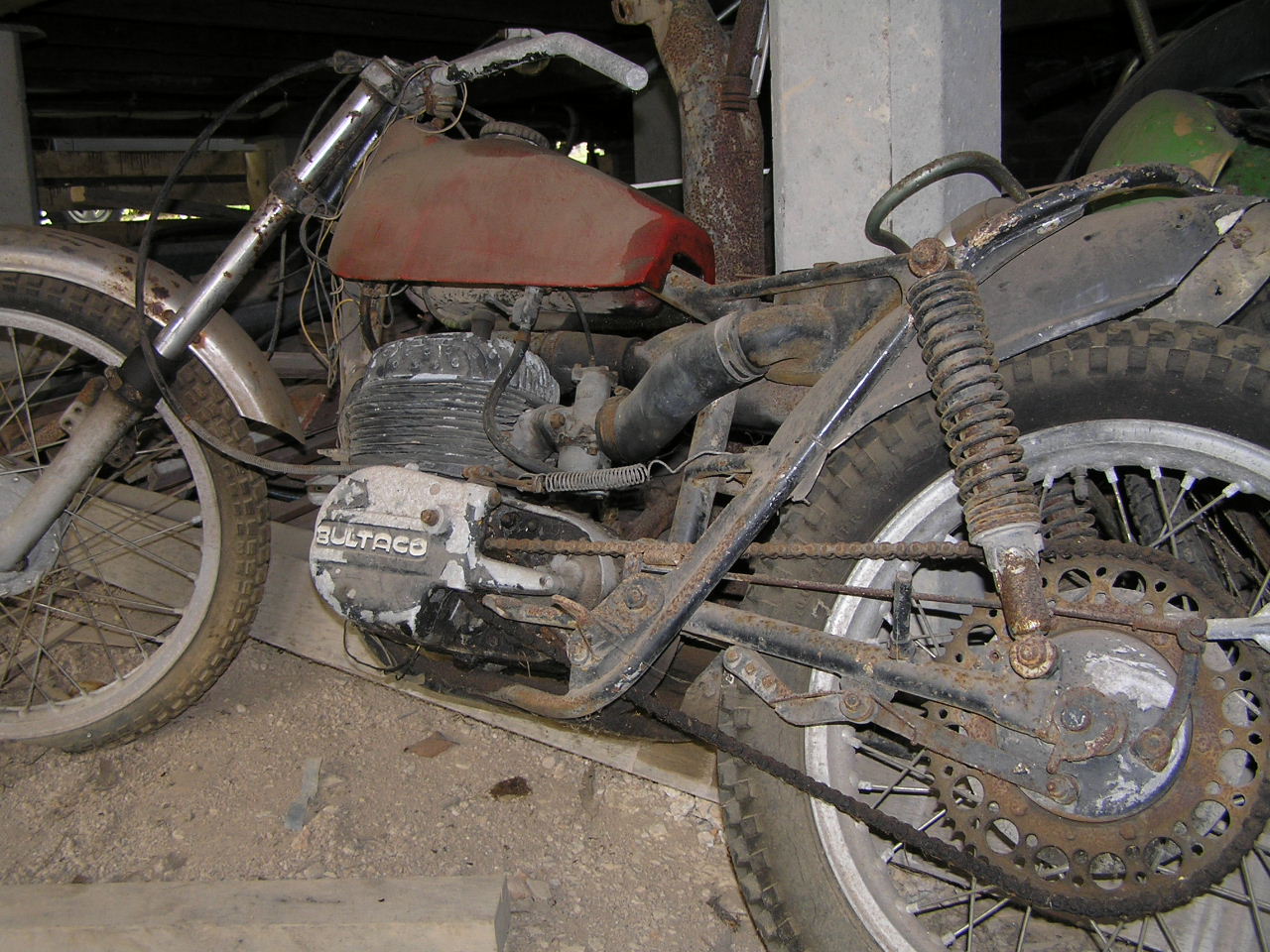
And here is a standard LH peg on a different M49
-
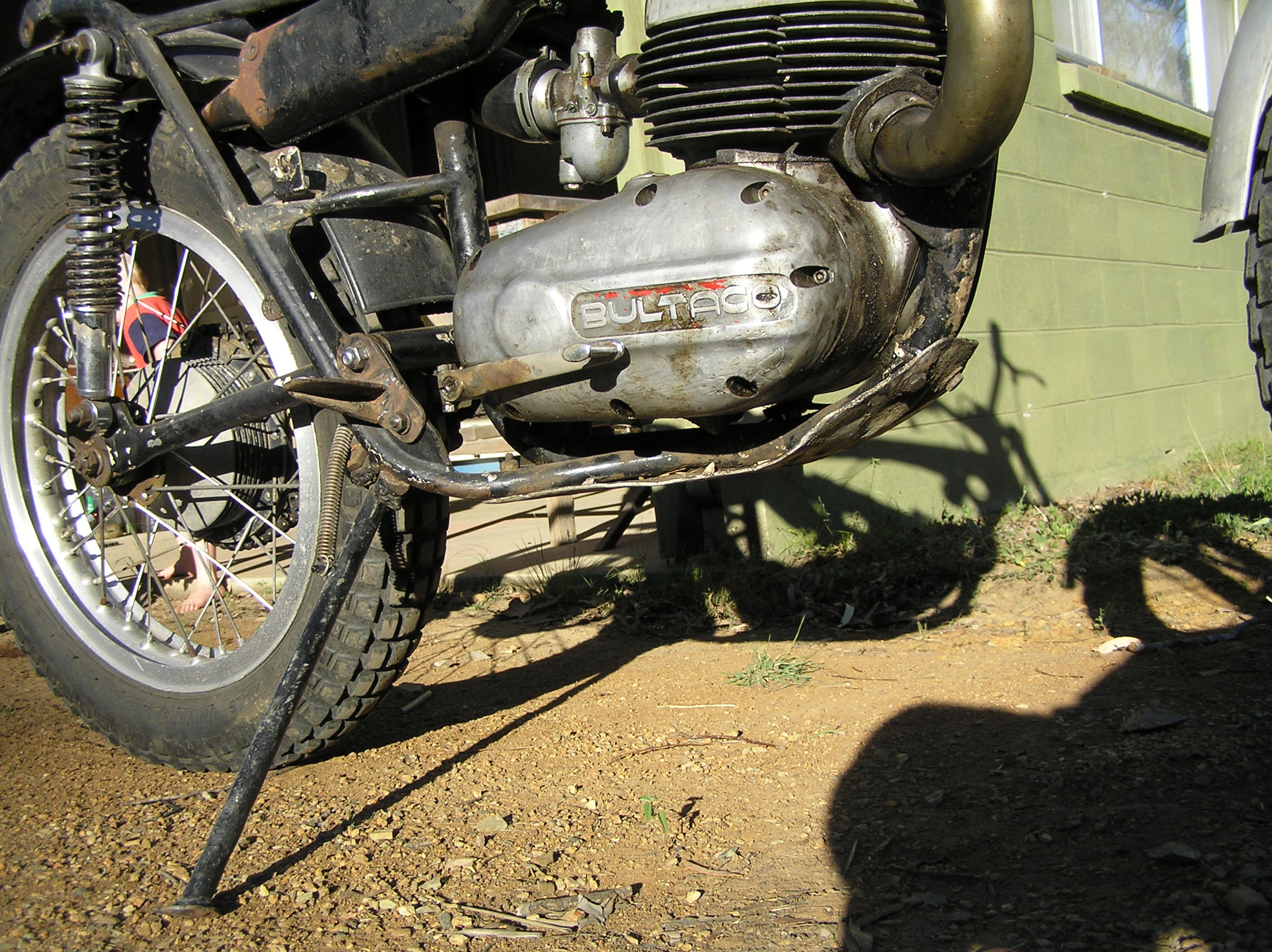
I just read your post again. Here is what the standard pegs look like.
-
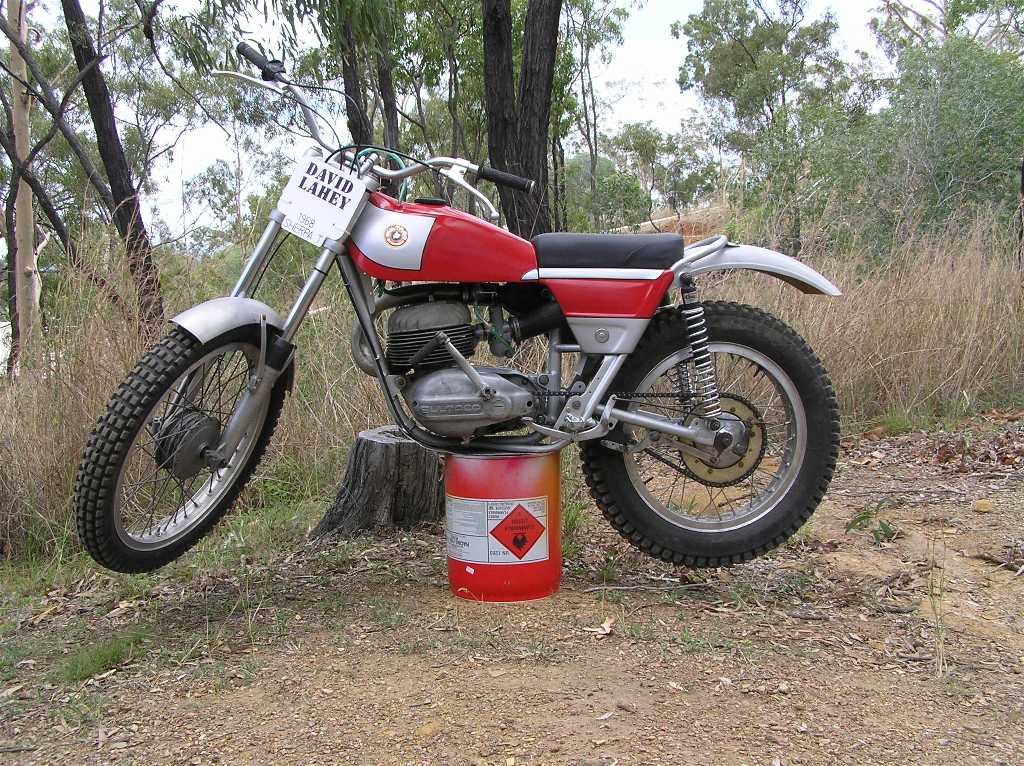
Here is what my series 1 M49 brake lever looks like. ID number is M4900100. This bike has been fitted with folding pegs to meet safety standards in competition, but it came standard with the fixed footpegs. I'm assuming you know what the fixed pegs look like. If not I can post a photo showing the original pegs.
-
Yes 25 normally means 0.25mm oversize which is first oversize. The bolts that hold the cylinder on are aluminium nuts and usually cause problems if they have never been off before but your being first oversize may be less frozen in place. The main problem is usually corrosion product and dirt between the OD of the nut and the cylinder. If there is no way to grip the nut or loosen it, you can drill the stud away and fit a new stud and nut. A simple cylindrical steel drill guide that fits neatly in the hole through the fins will allow you to keep the drill on track.
-
It doesn't matter if it is a Bultaco or a Montesa or a whatever, if it has a decent spark, correct timing, enough compression and not too lean on the idle and pilot mixtures, it will start first kick when warm. That must be exhausting kicking a 325 that much. If my 348 Monty didn't start first kick when warm, I don't think I would be able to finish a trial - I would be so exhausted. It should start on first or second kick when cold too. From what I've found, 325s are sensitive to the timing of the spark being just right for easy starting when warm. For the poor cold starting, it may be a carby problem too making it worse. If you have the Amal with a tickler, try leaning the bike over a bit to raise the hole where the fuel comes out, to get a bit more into the motor when you do the tickling. That works for my bikes with tickler Amals (M49 Sherpa T and M138 Alpina).
-
Yellow or orange or white TY175 and what country?
-
Steve, in my browser at home, your photos were mirror-imaged so I joked about it being a left handed motor. I'm at work now on a different computor (and sober) and the pictures are the right way around. Sorry for the confusion. David
-
If you heat the case with gravity helping they will probably just fall out. Use an oven to heat it evenly to about 160 degrees C.
-
This might be a little obvious but you didn't actually say if you checked that there was coolant in the coolant system or not. There is no crankcase breather on a two stroke. Do you mean gearbox breather or coolant system overflow line or mag case breather?
-
I see you have a special left-handed Cota 349 there with the primary drive and gearshift on the left side. That must be a rare one! Congratulations by the way. Good to see you are getting closer to getting it running right. I can feel for you as I went through similar on my 348.
-
Yes your problem is probably with your fuel. Rev 3s tend to do that on fuel that is too old or is too low an octane rating. You can reduce it by optimising your pilot jet size but if you use good fuel you will probably not have to do anything else.
-
I suspect that if you could ride both bikes back to back, you would pick the substantial improvements in suspension, weight, steering and braking. The other consideration is that the clubman route is probably so easy that you could comfortably ride it on a Twinshock. We had a series here last year that rode on clubman lines and the twinshock class was won by a rider on a legit pre-65 bike - and if he had entered the clubman class and ridden against modern bikes on his pre-65, he would have won clubman class. He's not a special rider - it's just that clubman is not usually difficult enough to give modern bikes any advantage.
-
Yours looks like a Series 2 Cota 247. It may well be from 1974 but they sold the same bike for a few years probably 1973 - 1975. I think the Series 3 247 (Ulf Karlsson Replica) came out in 1976.
-
The diameters may be right but is the length right too?
-
Maybe it was this one about Cota 348 jetting http://www.trialscentral.com/forums/index....c=23543&hl=