
feetupfun
Members
-
Joined
-
Last visited
Everything posted by feetupfun
-
I have that gearbox output shaft arrangement on my 348 and have not had a problem with the sprocket splitting or slipping. My sprocket is a TALON purchased in the 2000s. Some thoughts came to mind when I read your post: Maybe faulty sprocket (possible incorrect heat treatment process) Maybe a lubricant was used on the taper during fitting of the sprocket A clear photo showing the fracture surfaces of the sprocket should show if the problem is a faulty sprocket.
-
I remember from apprenticeship college having to make a square plug about 25mm long and 25mm across the flats from a piece of round and a square hole in a piece of flat plate all with hand tools and it had to fit perfectly all eight ways and all the way along. Lots of filing in that one
-
Yes there is not a huge difference in the voltage generated by the lighting coil compared with the LT coil. The ignition might have even worked with the lighting coil in the original position, because there are four magnets and the coils are opposed on the stator plate. I was working on a friend's TY175 and was having a hellova time trying to get the flywheel off. After many hours of heating/cooling it popped off unexpectedly and fell on the concrete floor (the bike was up on a bike workbench so it fell about a metre). One of the four flywheel magnets broke in the impact. Luckily the broken magnet was one that is only used by the lighting coil. I removed the broken magnet and the opposing magnet (to keep it balanced) and the ignition still worked fine.
-
I don't think that nikasiling the bore would make any difference to how well it ran compared with a fresh rebore. Doing the clutch basket fingers sounds like something that might be useful though
-
03 is yellow graphics. 05 is red and black graphics. Maybe you could post up a photo of the stator you want to identify.
-
We have a cut-off date of 1 Jan 1987 which seems to cover most trials bike originally made as twinshocks, but not the much-later RTX
-
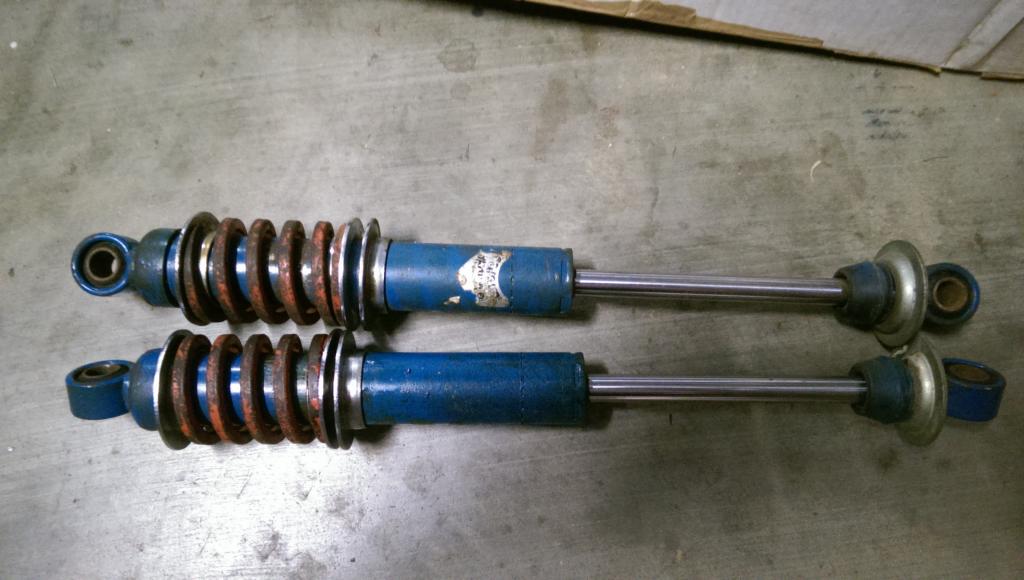
Here is what trials gas girlings from that era look like with the long spring removed Yours look like someone has fitted spacers to limit the shaft travel
-
Why do you have to choose one or the other? There is nothing wrong with having some of each
-
I only ride twinshocks but concede that a newby to trials would probably learn trials techniques faster on a modern
-
http://www.ebay.com.au/itm/Betor-Rear-shock-seals-Bultaco-OSSA-Made-in-USA-/252149753514?hash=item3ab54be6aa:g:FlwAAOSwhcJWNDK5
-
See if you can nobble the damping on the Curnutts or the Works Performance shocks while you have them apart. Standard they have way too much damping in both directions for trials use. For your friend getting the four original type Betors, there is a bloke in the USA selling shaft seals for them and you can also get the mounting rubbers. I sometimes run them on my OSSA. they are not quite as good as modern Falcons for damping action, but I love the look of them
-
I've heard the bottom bits (of pre-USD forks) that the wheel axle connects to called bottles, sliders and legs. I've also heard the whole assembly called a leg. I've heard the long tubular bits with the smooth shiny surface called tubes, stantions, staunchions, stantons, stornchons, sliders and legs There is nothing wrong with calling anything anything, as long as the message is successfully communicated. When the initial question was asked, I wondered what the writer meant by "tarnished" I'm still trying to work it out what "tarnished front forks" means to the writer, hoping I can help with the problem
-
Anodising is a hard coating on aluminium and is a form of aluminium oxide. Some oven cleaners contain sodium hydroxide. Sodium hydroxide solution dissolves both aluminium and aluminium oxide
-
never heard of a slide with zero cutaway. Is it fitted the right way around?
-
-
Did the plates move out parallel? Even with very flat plates, if the springs are not preloaded evenly, the release travel will be long because the pressure plate tilts
-
The release travel required depends on the sum of the out-of-flatness of all the plates. The fibre plates (outer plates) I've put in one of my Bultacos (Barnett) were very flat and did not increase the travel required. The production method of the original Bultaco plates is stamping, which is a method that by its nature introduces some degree of out-of-flatness (depending on the condition of the shearing edges) It is very common to see high and low spots on used OEM Bultaco plates, which is evidence of their lack of flatness
-
It is much easier to set the clutch up with the perfect amount of preload on the springs if you replace the clutch inner with one that has threaded rods and nuts for the clutch springs instead of the clutch inner that has the pins-through-holes spring retainers.
-
Sprocket: The sprocket is on a taper. If you use heat to help it break free it will probably melt the oil seal but if you are rebuilding the motor it probably doesn't matter. I usually cut old sprockets off my 348 with a 100mm angle grinder. Works a treat Crankshaft: Remove the seal holder Warm the casing to free up the bearing outer
-
A friend in the 1970s ran his almost-new Suzuki Waterbottle (GT750) on straight petrol (with the oil injection system not functioning) for a few weeks of riding to work. He pulled the cylinders off expecting carnage but the top ends were still perfect
-
A router is flash. I use a hacksaw
-
Kind-of-porky OSSA MARs and every other twinshock I have ridden go much better with modern tyres than they did with old style tyres
-
MT13 Pirelli was certainly the hot ticket when I was a kid (late 1970s). My memory tells me that the other proper trials tyres at the time were either Avon or Dunlop
-
There is no law against using a roller. I've seen plenty of twinshocks with a roller on the tensioner arm instead of a slider. Whatever rocks your boat.
-
Wet trial = heat up brakes after trial before loading bike into transporter to get drum surfaces as dry as possible. When I get home, clean external mud off bike then take wheels out and dry brake parts fully. Then some time before the next ride, service the brakes